


New, robust approach to overvoltage protection for sensitive electronic signal inputs

High demands on the robustness of electronic systems, especially in industrial environments, continually present developers with great challenges. Overvoltage protection is one key design consideration and challenge, as additional components are usually required to protect systems from overvoltage events – yet they frequently impact and, in the worst case, can even falsify signals. Beyond that, these components incur additional costs and contribute to spatial constraints. Hence, when designing the protection circuit, traditional solutions often require a compromise between system accuracy and the protection level.

Typically, a common and simple design method uses external protection diodes, usually transient voltage suppressor (TVS) diodes, clamped between the signal line and supply or ground. TVS diodes are advantageous as they can react instantaneously to temporary voltage spikes. This type of external overvoltage protection is shown on the left side of Figure 1.
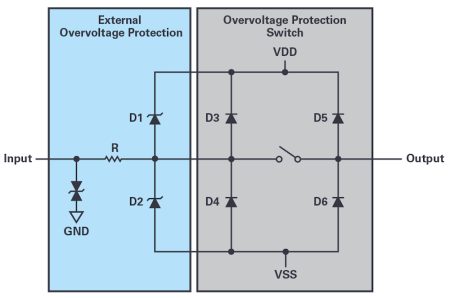
Figure 1. Traditional overvoltage protection design with additional discrete components.
If a positive transient voltage pulse occurs, it is clamped with a current through diode D1 to VDD. The voltage is thereby limited to VDD plus the diode forward voltage. If the pulse is negative and less than VSS, the same applies with the exception that it is clamped to VSS via D2. However, if the leakage current caused by the overvoltage is not limited, it may damage the diodes. For this reason, there is also a current-limiting resistor in the path. For very harsh environmental conditions, an input-side bidirectional TVS diode is often used for enhanced protection.
The disadvantages resulting from this type of protection circuit appear – for example, in the form of increased edge rise and fall times and capacitive effects. Moreover, it doesn’t provide any protection when the circuit is in the de-energised state.
The actual components, such as analogue-to-digital converters (ADCs), operational amplifiers, etc., usually have integrated protection. This can consist of a switch architecture, as shown on the right side of Figure 1. Figure 1 also shows that input-side and output-side protection diodes are present on both supply rails. The downside to this setup is that, when floating signals appear in a de-energized state (the IC is not powered up), the switch may act as if it is active (even if it is set to OFF) as current will flow through the diodes and the power supply rails. This allows current to pass through, resulting in the signal line losing its protection.

Fault-Protected Switch Architecture
One solution to the challenges mentioned above is a fault-protected switch architecture supplemented by a bidirectional ESD cell, as can be seen in Figure 2. Instead of the input-side TVS diodes, now the ESD cell clamps voltage transients by constantly comparing the input voltage with VDD or VSS. In the case of permanent overvoltage, the downstream switch opens automatically. The input voltage is no longer limited by the protection diodes clamped to the supply rails. The limiting factor is now the maximum voltage rating of the switch. Higher system robustness and reliability are additional advantages. There is also virtually no effect on the actual signals and their accuracy. Moreover, the additional current-limiting resistor is not needed because the leakage currents are very low when the switch is open.
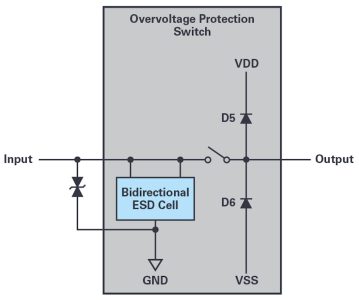
Figure 2. Overvoltage protection with integrated bidirectional ESD cell.

This type of input structure is characteristic of the quad SPST (single-pole, single-throw) switch ADG5412F from Analog Devices Inc. (ADI). This switch permits a permanent overvoltage of up to ±55V, regardless of any existing voltage supply. The ESD cell integrated on each of the four channels clamps voltage transients of up to 5.5kV. In an overvoltage condition, only the affected channel is opened and the other channels continue operating normally.

Conclusion
Thanks to this type of overvoltage protection switches, electrical circuits can be greatly simplified. The advantages over the conventional discrete solution are multitudinous, both in terms of guaranteeing optimal switching performance and robustness in a precise signal chain and in terms of spatial optimisation. Hence, the overvoltage protection offered by the ADG5412F is especially suitable for high precision measurement applications in harsh environments.

About the Author
Thomas Brand began his career at Analog Devices in Munich in 2015 as part of his master’s thesis. After graduating, he was part of a trainee program at Analog Devices. In 2017, he became a field applications engineer. Thomas supports large industrial customers in Central Europe and also specialises in the field of Industrial Ethernet. He studied electrical engineering at the University of Cooperative Education in Mosbach before completing his postgraduate studies in international sales with a master’s degree at the University of Applied Sciences in Constance. He can be reached at thomas.brand@analog.com.


> Read More

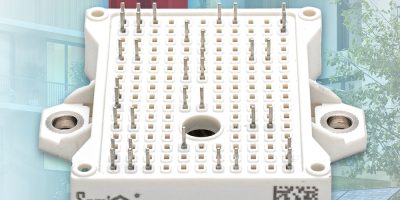
SemiQ unveils high-performance QSiC power modules in half-bridge packages

SemiQ has expanded its QSiC power modules portfolio with the introduction of a new series of 1200V silicon-carbide (SiC) power MOSFETs in half-bridge packages.

Engineered and tested to operate reliably in demanding environments, these new compact, high-performance modules enable high-power-density implementations while minimising dynamic and static losses. Featuring high breakdown voltage (>1400V), the new QSiC modules support high-temperature operation (Tj = 175°C) with low Rds(On) shift over the full temperature range. In addition, the modules exhibit industry-leading gate oxide stability and long gate oxide lifetime, avalanche unclamped inductive switching (UIS) ruggedness and long short-circuit withstand time.

With a solid foundation of high-performance ceramics, the new SiC modules are suitable for EV charging, on-board chargers (OBCs), DC-DC converters, E-compressors, fuel cell converters, medical power supplies, photovoltaic inverters, energy storage systems, solar and wind energy systems, data centre power supplies, UPS/PFC circuits, Vienna rectifiers, and other automotive and industrial applications.

To ensure that each module has a stable gate threshold voltage and high-quality gate oxide, SemiQ’s modules undergo gate burn-in testing at the wafer level. Besides the burn-in test, which helps to stabilise the extrinsic failure rate, stress tests such as gate stress, high-temperature reverse bias (HTRB) drain stress, and high humidity, high voltage, high temperature (H3TRB) allow achieving the required automotive and industrial grade quality levels. The devices also have extended short-circuit ratings. All modules have undergone testing exceeding 1350V.

https://semiq.com/

> Read More

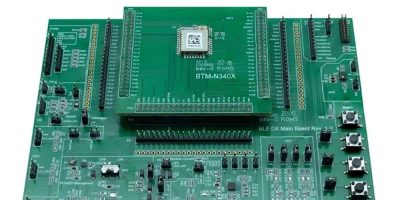
Nordic-powered module provides Bluetooth LE audio connectivity

Wireless communications company Rayson Technology has released a multiprotocol module based on Nordic Semiconductor’s nRF5340 System-on-Chip (SoC). The SoC is designed for advanced Bluetooth LE audio applications, as well as sophisticated metering, wearable, smart home, industrial, and medical use cases. Measuring just 16.5 by 13.0 by 2.5 mm, the ‘BTM-N340X’ module supports LE Audio and its Low Complexity Communication Codec (LC3), which together enable higher quality, lower power wireless audio streaming compared with existing Classic Bluetooth audio solutions.

The module employs the nRF5340 SoC’s dual Arm Cortex-M33 processors – providing a high performance application processor capable of DSP and Floating Point (FP) alongside a fully programmable, ultra low power network processor. The application core manages the LC3 codec, while the Bluetooth LE protocol is supervised by the network processor.

“The BTM-N340X module has been designed for a wide range of applications, aiming in particular to provide enhanced audio experiences via Bluetooth LE Audio,” says Bob Wu, CTO at Rayson Technology. “It enables one device to stream audio to multiple pairs of wireless headphones, and can facilitate audio broadcasts through public address systems, such as in airports and museums. This module is also compatible with smart speakers and home audio systems.”

The module’s ultra-low power consumption is made possible due to the nRF5340’s power-optimised multiprotocol radio, which offers a TX current of 3.4 mA (0 dBm TX power, 3 V, DC/DC) and RX current of 2.7 mA (3 V, DC/DC). The sleep current is as low as 0.9 µA. Additionally, because the cores can operate independently, developers have the flexibility to optimise performance for power consumption, throughput, and low latency response.

Two flexible antenna options are available for the module—a pre-certified U.F.L Connector and a PCB pin out—depending on the product application. The module is designed to operate within a temperature range of -40 to +85°C.

“The dual processors made the nRF5340 SoC an excellent choice for this module’s LE Audio applications,” says Wu. “The large memory capacity, radio sensitivity, and low power consumption were also major drawcards. In addition to the excellent technical capabilities of the chip, the high level of support from Nordic was a key factor when making our selection.”

https://www.nordicsemi.com

> Read More

Supermicro offers rack scale solutions with new 5th gen Intel Xeon processors 

Supermicro, announces rack scale air and liquid cooled solutions based on the X13 family of workload-optimised servers now support the new 5th Gen Intel Xeon processors (formerly codenamed Emerald Rapids). The new product lineup includes GPU servers for Generative AI, throughput and latency-optimised E3.S Petascale servers, cost-effective high-density Enterprise and Simply Double storage servers for large-scale object storage, and a new 4-node SuperEdge systems with enhanced storage capacity.

Supermicro X13 systems take advantage of the new processors’ built-in workload accelerators, enhanced security features, higher core count, more last-level cache, and increased performance within the same power envelope as the previous generation of Intel Xeon processors. The 5th Gen Intel Xeon processors provide a 36% higher average performance/watt across workloads vs. 4th Gen Intel Xeon Scalable processors.

The new Intel Trust Domain Extensions (Intel TDX) are built into the CPU die. Supermicro X13 systems also include firmware protected hardware root of trust (RoT) compliant with NIST 800-193, as well as benefiting from Supermicro’s supply chain attestation and ‘Made in the USA’ program for added security from production to end customer.

“5th Gen Intel Xeon processors deliver meaningful performance and efficiency improvements for our customers’ most important workloads,” said Lisa Spelman, corporate vice president and general manager Xeon Products & Solutions at Intel. “Supermicro’s X13 range of servers are designed to give customers the fastest path to increased performance given their compatibility with 4th Gen Xeon based platforms already in the market.”

Among the new additions to the broad X13 server range is a new dual processor GPU server with 8 Intel Data Centre GPU Max 1550 OAM GPUs optimised for large-scale AI training, generative AI, and HPC applications. The Intel Data Centre GPU Max 1550 GPUs utilises the open-standard Open Accelerator Module (OAM) form factor for flexible high-speed interconnect and contains 128GB of HBM2e memory for a maximum GPU memory bandwidth of 3276.8 GB/second. Both CPU and GPU direct-to-chip liquid cooling are available on the system via Supermicro’s complete rack integration and liquid cooling solutions.

Supermicro is also launching several new servers supporting the new Intel Xeon E-2400 processors (formerly codenamed Catlow Platform, Raptor Lake-E). The new systems are optimised for maximum efficiency Edge and Cloud workloads and include the I/O flexible WIO, storage-optimised, short-depth, and mid-tower configurations, as well as multi-node Supermicro MicroCloud and Supermicro MicroBlade architectures. The new Intel Xeon E-2400 processors have up to 8 cores and a top frequency of 5.6 GHz. These servers are available for shipping immediately

https://www.supermicro.com/

> Read More

About Smart Cities

This news story is brought to you by smartcitieselectronics.com, the specialist site dedicated to delivering information about what’s new in the Smart City Electronics industry, with daily news updates, new products and industry news. To stay up-to-date, register to receive our weekly newsletters and keep yourself informed on the latest technology news and new products from around the globe. Simply click this link to register here: Smart Cities Registration