
The smart evolution of Bluetooth module from Panasonic

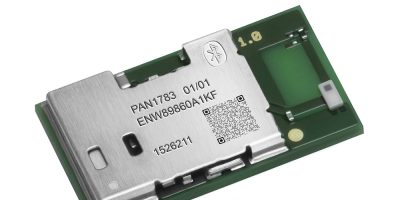
Panasonic has announced the release of PAN1783, a Bluetooth 5.4 Low Energy (LE) module that follows the PAN1780. Building upon the success of its predecessor, the PAN1780, the PAN1783 sets new standards in performance, versatility, and efficiency.

According to Tomislav Tipura, Product Manager at Panasonic Industry Europe’s IoT Department, “the PAN1783 represents a significant leap forward in Bluetooth technology, offering unparalleled features and capabilities to meet the evolving needs of our customers.”

Being as compact as 15.6 x 8.7 mm, the PAN1783 is one of the smallest nRF5340 module currently available in the market. It is powered by the Nordic nRF5340 single-chip controller, boasting isochronous channels for LE audio support. This module is available with both an on-board chip antenna and an RF-bottom pad, providing flexibility to suit various design requirements – CE RED, FCC, UKCA und ISED certificates included!

Featuring Bluetooth 5.4 enhancements, including isochronous channels, LE audio, and support for high-throughput of 2 Mbps, advertising extensions, and long range, the PAN1783 delivers exceptional performance, according to Panasonic. Its all-in-one System-on-Chip (SoC) design combines the best features of the nRF52 Series with increased performance and memory, all while minimising power consumption. The improved sensitivity of the nRF5340, coupled with the LE coded PHY, makes the PAN1783 an attractive choice for a wide range of applications, including advanced computer peripherals, I/O devices, wearables, and wireless audio devices. Moreover, its ultra-low current consumption makes it ideal for battery-powered devices, extending operational lifespans.

Equipped with two Cortex-M33 processors – one as an application processor and the other as a network processor – the PAN1783 offers seamless integration and standalone operation. This eliminates the need for an external processor, simplifying design, reducing space requirements, and ultimately helps lowering costs for manufacturers.

In addition to its Bluetooth capabilities, the PAN1783 supports angle of arrival (AoA) and angle of departure (AoD) direction finding, enhancing location-based services and applications. Furthermore, it also supports Type 2 Near Field Communication (NFC-A), facilitating simplified pairing and payment solutions when used with an external antenna.
https://industry.panasonic.eu

> Read More

New Silicon Labs Wi-Fi 6 plus Bluetooth modules for embedded IoT applications

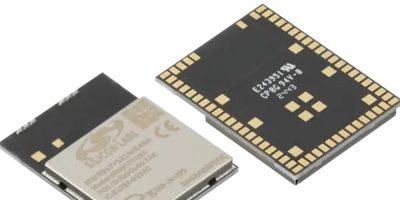
Mouser is now shipping the new SiWx917Y wireless modules from Silicon Labs. The SiWx917Y wireless modules provide ultra-low-power Wi-Fi 6, Bluetooth® Low Energy (LE) 5.4, and Matter connectivity for a host of embedded, battery-powered IoT devices in smart homes, consumer, industrial, and healthcare applications.

The Silicon Labs SiWx917Y series are fully integrated, shielded modules with a dedicated wireless processing subsystem, an application processing subsystem (MCU), and an advanced security engine. They have a rich set of peripherals framed by an intelligent power management subsystem that includes an antenna (or RF-pin) and worldwide RF regulatory certifications, simplifying development and certification processes.

The SiWx917Y modules’ processing subsystem consists of a network wireless processor (160MHz), baseband digital signal processing, an analog front end, a 2.4 GHz RF transceiver, and a power amplifier. The application processing subsystem features an ARM Cortex-M4 with FPU at 180 MHz, a large, embedded SRAM, Flash, PSRAM, and an option for external Flash/PSRAM. The modules come with modular radio-type approvals for various countries, including the US (FCC), Canada (IC/ISED) and Japan (MIC), and follow the relevant EN standards (including EN 300 328 v2.2.2) for conformity with directives and regulations in EU and UK.

https://eu.mouser.com

> Read More

Renesas unveils Lithium-Ion battery management platform with pre-validated firmware

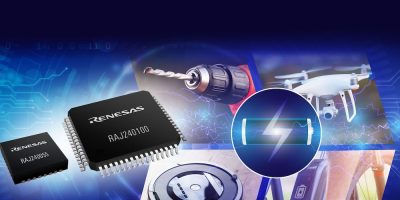
Renesas has introduced all-in-one solutions for managing lithium-ion battery packs in a wide range of battery-powered consumer products, such as e-bikes, vacuum cleaners, robotics and drones. With pre-validated firmware provided, the R-BMS F (Ready Battery Management System with Fixed Firmware) will reduce the learning curve for developers, enabling rapid designs of safe, power-efficient battery management systems.

Designed for lithium-ion batteries in both 2-4 and 3-10 cell series (S), R-BMS F solutions include Renesas’ fuel gauge ICs (FGICs), an integrated microcontroller (MCU) and an analog battery front end, pre-programmed firmware, software, development tools and full documentation – all available in complete evaluation kits that are now ready to ship.

Firmware is essential in battery management systems as it is used to monitor batteries’ state of charge (SoC), state of health (SoH), current, and temperature, as well as actively balancing the voltages of the individual cells, and detect faults. In some cases, however, consumer electronics developers may lack the highly specialised expertise needed to develop control algorithms that keep the batteries operating in a safe temperature region and ensure adequate battery life over many charge/discharge cycles.

Renesas’ R-BMS F solutions include built-in, pre-tested firmware designed to work with the FGIC’s on-board MCU. The firmware includes critical pre-programmed functions to maximize battery life and ensure safe operation. These include cell balancing, current control, and voltage and temperature monitoring. For added flexibility, the battery management system lets developers set many parameters to meet specific requirements and adjust the solution for different cell chemistries via a graphical user interface (GUI), without the need for a full integrated development environment (IDE).

Both R-BMS F solutions contain a full evaluation kit, which has all the hardware, software, tools and documentation required to start developing. The underlying hardware powering the R-BMS F is Renesas’ FGIC solution, which combines an analog battery front end and an ultra-low-power RL78 MCU into a single, small package. The analog portion provides accurate measurements of cell voltage, current and temperature, as well as controlling the external MOSFETs and converting analog data to digital signals. The digital section is where synchronous functions reside, including the main CPU, clocks, timers and serial interfaces. Also included in the evaluation kits are: pre-programmed firmware stored in embedded flash memory with the flexibility to set the battery pack and cell chemistry parameters; the USB System Management Bus (SMBus) interface; GUI-based software; cables to communicate with the host system; dedicated development tools for parameter setting; and full documentation, including schematics and an engineering bill of materials (eBOM). With these resources, developers can confidently innovate intelligent power management systems that safely monitor battery usage and provide longevity, while reducing their impact on the environment. Renesas plans to include turn-key R-BMS F solutions in all future FGICs.

The R-BMS F for 2 to 4S cell (~8V to 16V) solutions targets small vacuum cleaners, robotic vacuums, consumer and medical devices and runs on Renesas’ RAJ240055 Li-ion battery FGIC. Renesas offers Smart Robot Vacuum Cleaner | Renesas by combining this FGIC with other devices from its portfolio.

The R-BMS F for 3 to 10S cell (~12V to 40V) solutions runs on Renesas RAJ240100 and RAJ240090 Li-ion battery FGICs, with target applications including e-bikes, e-mobility, vacuum cleaners, robotics, drones and industrial, consumer and medical systems.

https://www.renesas.com

> Read More

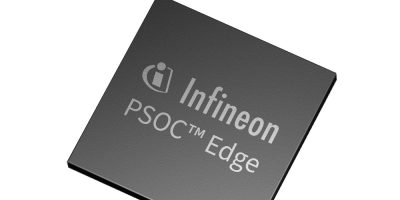
Infineon advances Edge AI computing on PSOC Edge with NVIDIA TAO toolkit integration

Microcontrollers (MCU) are at the heart of modern electronics, and integrating the latest AI development and deployment workflows at the edge poses a major challenge for developers. The combination of a high-performance MCU with NPU hardware acceleration and an advanced AI fine-tuning workflows will enable developers to accelerate the deployment of AI models in low-power MCUs: Infineon has today announced support for NVIDIA TAO models on the PSOC Edge MCU family.

Infineon’s PSOC Edge MCU family features Arm Cortex-M55 processors and Ethos-U55 microNPU and enhances energy-efficient machine learning capabilities at the edge. The combination of these versatile microcontrollers with the powerful NVIDIA TAO models and fine-tuning toolkit greatly simplifies the creation, customisation, optimisation, and deployment of high accuracy vision AI models.

“NVIDIA is a key player in the AI/ML space, so we and our lead customers engaged in vision, audio and voice applications are very excited about this effort,” said Steve Tateosian, Senior Vice President IoT Compute & Wireless at Infineon. “By integrating NVIDIA TAO in our PSOC Edge portfolio, we empower developers to create smarter and more efficient systems that work at the edge of the network and solve real-world challenges with speed and precision. This significantly speeds up time-to-market for ML enabled applications in industrial automation, medical, automotive, and smart IoT solutions.”

“NVIDIA TAO brings the latest advances in computer vision models and fine-tuning workflows to the far edge”, said Deepu Talla, Vice President of Robotics and Edge Computing at NVIDIA. “Infineon PSOC Edge’s integration of NVIDIA TAO greatly simplifies the development and deployment of customised AI across a range of devices.”

The integration of NVIDIA TAO features will become available for the entire PSOC Edge family along with a comprehensive development ecosystem, including tools, libraries, and documentation, to accelerate innovation and reduce time-to-market for AI-enabled applications.

https://www.infineon.com

> Read More

About Smart Cities

This news story is brought to you by smartcitieselectronics.com, the specialist site dedicated to delivering information about what’s new in the Smart City Electronics industry, with daily news updates, new products and industry news. To stay up-to-date, register to receive our weekly newsletters and keep yourself informed on the latest technology news and new products from around the globe. Simply click this link to register here: Smart Cities Registration