


Qualcomm launches mobile processor with fully integrated RFID capabilities

Qualcomm has announced the Qualcomm Dragonwing Q-6690, which is the world’s first enterprise mobile processor with fully integrated UHF RFID capabilities. The processor includes built-in 5G, Wi-Fi 7, Bluetooth 6.0, and ultra-wideband, supporting proximity-aware experiences and global connectivity. Designed to support a wide range of form factors from ruggedised handhelds to retail point-of-sale systems and smart kiosks, the Dragonwing Q-6690 offers OEMs and ODMs a scalable and upgrade-ready platform with software-configurable feature packs that can be upgraded over the air.

“The Dragonwing Q-6690 combines integrated RFID, AI, and next-gen wireless capabilities in a single, scalable platform, designed to accelerate innovation across industries including retail, logistics, and manufacturing,” said Art Miller, vice president and head of retail, Qualcomm Technologies, Inc. “We are particularly excited about working with retailers today that need platforms that are not only powerful and connected, but also adaptable to evolving customer expectations, from smarter kiosks and handhelds to real-time inventory analytics and contactless experiences.”

The Dragonwing Q-6690 is the world’s first enterprise mobile processor with fully integrated RFID capabilities, eliminating the need for external RFID reader modules and therefore enabling smaller, more efficient device designs. This integration eases the enablement of security-focused, contactless use cases such as access control, asset tracking, inventory management, and product authentication, ideal for retail, logistics, and industrial applications. For more information on the benefits of embedded RFID, visit OnQ blog.

The Dragonwing Q-6690 introduces software-configurable feature packs that let OEMs choose their offerings depending on the computing demands, multimedia capabilities, camera support, or peripheral configurations they need—with the ability to upgrade over the air without redesigning hardware. This modular approach not only accelerates time to market and reduces certification overhead but also extends product lifecycles by enabling over-the-air upgrades as customer needs evolve.

https://www.qualcomm.com

> Read More

Easily integrate technology with Microchip’s portfolio of GNSS disciplined oscillator modules

Aerospace and defence applications rely on Position, Navigation and Timing (PNT) technology for mission-critical accuracy and reliability. However, integrating PNT into a design requires extensive domain knowledge in this area. To fast track the development process, Microchip has announced its portfolio of GNSS Disciplined Oscillator (GNSSDO) Modules that integrate the company’s embedded atomic clock and oscillator technologies, including the Chip-Scale Atomic Clock (CSAC), Miniature Atomic Clock (MAC) and Oven-Controlled Quartz Crystal Oscillators (OCXOs).

The GNSSDO modules process reference signals from GNSS or an alternative clock source and disciplines the on-board oscillator to the reference signal, enabling precise timing, stability and holdover performance based on end application requirements. These GNSSDOs are used in military and defence applications such as radar, satellite communications (SATCOM), mounted and dismounted radios, vehicle platforms and other critical PNT applications including GNSS-denied environments.

A GNSSDO module acts as a PNT subsystem within a larger system design or as a stand-alone system, providing precise timing that is critical to any high-performance system. The local oscillators used in the GNSSDO modules are engineered and manufactured by Microchip, ensuring customers have a product that they can trust. Other Microchip components on the module include 32-bit microcontrollers (MCUs) and SmartFusion® 2 FPGAs.

Microchip’s newly released GNSSDO modules include:

• The MD-013 ULTRA CLEAN is Microchip’s highest performance standard GNSSDO module that can support multiple GNSS constellations, including GPS, Galileo, BeiDou, and NavIC or an external reference input. This module is designed around a high-performance OCXO that enables outputs with ultra-low phase noise and short-term frequency stability characteristics. The respective specifications for phase noise performance are −119 dBc/Hz at a 1 Hz offset and noise floor of −165 dBc/Hz. Short-term frequency stability, measured by Allan Deviation (ADEV), is 3E-13 at 1s tau, 6E-13 at 10s tau and 9E-13 at 100s tau.

This module can generate 1 PPS TTL, 10 MHz sine wave and 10 MHz square wave outputs that are disciplined to an embedded 72-channel single-band GNSS receiver, with the option to upgrade to a configurable L1/L2 or L1/L5 dual-band, multi-GNSS receiver.

• The MD-300 is Microchip’s GNSSDO module for harsh environments, available in a small 1.5 × 2.5-inch footprint. The MD-300 has an embedded MEMS OCXO or TCXO as the local oscillator, enabling low g-sensitivity, high shock and vibration tolerance and low thermal transient response. Due to its Size, Weight and Power (SWaP) performance, the MD-300 is well-suited for applications like drones and manpacks. The module can discipline to an embedded GNSS receiver or external reference and output high- performance 10 MHz and 1 PPS signals.

• The LM-010 is a PPS disciplined module that provides precise timing for Low Earth Orbit (LEO) applications that demand radiation tolerance coupled with stability and holdover capability. As a standard platform module, the LM-010 provides both 1 PPS TTL and 10 MHz sinewave outputs that are disciplined to an external reference input. Internal to the module is Microchip’s digitally corrected OCXO or low-power CSAC SA.45.

Microchip’s GNSSDO modules utilise a common serial communication protocol and Graphical User Interface (GUI) for command and control of the unit. A variety of parameters can be configured through the software including inputs, outputs, auto switching, holdover parameters, GNSS tracking and observables, as well as reporting messages coming off the serial interface.

Development Tools
The GNSSDO portfolio is supported by Microchip’s VDOM3 software and GUI to help developers adjust performance parameters of the GNSSDO modules and quickly test integrating these products into their systems. The MD-01X Evaluation Kit is also available to easily connect and monitor the MD-01 series of GNSSDOs.

https://www.microchip.com

> Read More

Latest Bluetooth module from Panasonic now in mass production and supporting Bluetooth 6.0

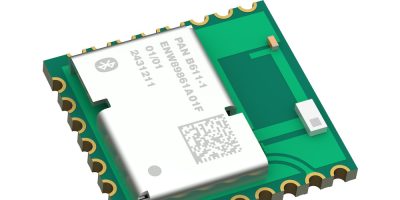
Now in mass production, the PAN B611-1 Bluetooth module from Panasonic Industry is based on the powerful Nordic nRF54L15 single chip controller. The product now also supports Bluetooth 6.0 and the cutting-edge Bluetooth Channel Sounding feature, enabling precise distance measurement and improved wireless communication.

All 32 pins available on nRF54L15 are routed out on to a hybrid packaging consisting of castellated edges and LGA in a hybrid layout such that a dedicated number of pins positioned at the edge lending for easy prototyping, with the rest of the GPIOs located at the bottom that allows leveraging the full potential of the wireless SoC platform.

The module benefits from very small dimensions of only 10.35 mm × 9.8 mm × 1.9 mm. This way, it combines the advantages of both worlds without compromising on size and enables one of the best pin-to-size ratios for Bluetooth modules currently on the market. Its edge pins facilitate easier hand-soldering and support the use of inexpensive 2-layer PCB designs and optical inspection methods, eliminating the need for costly X-ray machines.

Based on nRF54L15, the module is shipped with an open embedded application processor based on ARM Cortex-M33 processor clocking up to 128 MHz for high performance embedded applications with a 256 kB RAM. Furthermore, the module has a non-volatile memory of 1.5 MB as available on the SoC.

However, Panasonic adds further features above and beyond those available on the SoC. Pascal Maier, Head of IOT Devices at Panasonic Industry comments: “Our latest PAN B611-1 Bluetooth module is a versatile device that can support a variety of applications – from ultra-low power battery driven solution to very complex applications like Matter, as well as sophisticated algorithm-heavy features like Channel Sounding. This is why we offer different spec variants to enable a variety of applications. The modules are for example available with additional integrated slow clock crystal for energy efficient battery powered operation and additional 4 MB Flash Memory for more complex applications. We think our clients will love this module for its versatility and power at a competitive price point.”

An output power of 8dbm makes the module ideally suited for the European market. The main target applications are lighting, home appliances, industrial sensors, medical devices, healthcare wearables and energy management devices and solar farms.

Furthermore, the PAN B611-1 is ideally suited for Matter applications, as dedicated variants exist with additional flash memory, and is fully compatible with the PAN MAX Service that facilitates the production and launch of Matter production. Apart from Matter, the highly versatile module also supports a variety of wireless protocols in the 2.4 GHz spectrum including Bluetooth LE, Bluetooth Mesh and IEEE 802.15.4 – enabling Zigbee and Thread as well as other third-party proprietary technologies, which make it effortless to develop products for smart home standards like Matter and Zigbee and even allow running multiple wireless protocols concurrently.

The PAN B611-1 Bluetooth module is available with an integrated chip antenna (-1C) or as bottom pad version (-1B) to cater to diverse project needs. It is certified for Europe (CE RED), UK (UKCA), USA (FCC), Canada (ISED), Japan (MIC).

https://industry.panasonic.eu

> Read More

AAEON introduce an Intel Core Ultra 200H-powered developer board

AAEON’s UP brand has announced the release of the UP Xtreme ARL, its first product to feature the new Intel Core Ultra 200H Series platform (formerly Arrow Lake). The platform’s enhanced integrated CPU, GPU, and NPU provide up to 97 TOPs of AI performance, one of the reasons AAEON has positioned the product as a platform for professional developers to build advanced industrial robotics and Autonomous Mobile Robots (AMR) applications.

The board is the first Arrow Lake-powered embedded product to have obtained Intel ESQ (Edge Solution Qualification). This qualification ensures validated hardware and software integration for high-performance, reliable, and scalable AI edge computing applications.

The UP Xtreme ARL’s enhanced chip architecture sees the board leverage performance advancements through both a power-optimised core microarchitecture and Intel DL Boost-accelerated integrated Intel Arc 140T GPU. In addition, its Intel AI Boost NPU offers extensive software framework support, something that the brand’s UP Community will see as a big plus for streamlined model development.

As expected, the UP Xtreme ARL is equipped with a Raspberry Pi-compatible 40-pin GPIO, while also offering dual RS-232/422/485 pin headers, as well as MIPI-CSI camera support via a 61-Pin FPC connector. The board provides two USB 3.2 Gen 2 interfaces via two Type-A ports, alongside three USB 2.0 interfaces via one Type-A port and an internal 10-pin header offering an additional two. Alongside its varied USB configuration is two ethernet ports, one providing 2.5GbE and one Gigabit Ethernet speed. The board offers substantial expansion options, with two M.2 2280 M-Key slots joining one SATA drive for storage, alongside both M.2 2230 E-Key and M.2 3052 B-Key slots for wireless module support.

For OS support, the UP Xtreme ARL is compatible with Windows 10/11 LTSC, Ubuntu 24.04 LTS, and Yocto 5+. AAEON also provides a variety of drivers and setup documentation for GPU, NPU, and IPU functionality on its website product page.

https://www.aaeon.com.

> Read More

About Smart Cities

This news story is brought to you by smartcitieselectronics.com, the specialist site dedicated to delivering information about what’s new in the Smart City Electronics industry, with daily news updates, new products and industry news. To stay up-to-date, register to receive our weekly newsletters and keep yourself informed on the latest technology news and new products from around the globe. Simply click this link to register here: Smart Cities Registration