
ADLINK expands COM lineup featuring NXP i.MX 95 applications processor family

ADLINK Technology has announced its latest NXP-based IMX95 modules powered by the NXP i.MX 95 Applications Processor family. Engineered to meet the demands of aerospace, automotive edge, commercial IoT, industrial, medical, and networking sectors, these modules deliver a blend of performance, security, and efficiency—supported by a guaranteed 15-year product lifecycle to ensure long-term availability and stability.

At the core of the IMX95 modules is the NXP i.MX95 Applications Processor, featuring up to six-core Arm Cortex-A55 alongside Cortex-M7 and Cortex-M33 cores, providing multicore processing and real-time control. The integrated Neutron Neural Processing Unit (NPU), supported by the eIQ framework, delivers up to 2 TOPS, enabling advanced AI inference, computer vision, and real-time data analytics directly at the edge—all within a low-power design optimised for sustained workloads.
Complementing this AI capability, the NXP i.MX 95 Applications Processor modules feature an Image Signal Processor (ISP), Video Processing Unit (VPU), and Arm Mali graphics G310 GPU to support immersive 3D graphics and high-quality vision applications. With flexible memory configurations supporting up to 8GB LPDDR4L RAM and up to 256GB eMMC storage, plus multiple graphic output interfaces including DSI and LVDS, these modules offer extensive adaptability to varied application needs. They also include other standards found in all NXP products, ensuring broad compatibility and easy integration.

Connectivity options include USB 2.0/3.0 ports and high-speed Ethernet interfaces with Precision Time Protocol (PTP), ensuring seamless integration into diverse industrial environments.

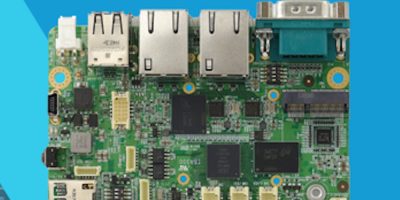
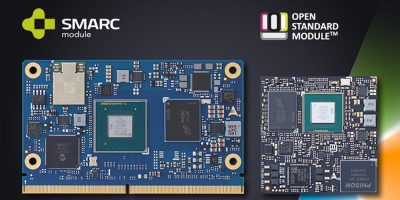
The ADLINK OSM-IMX95, compliant with SGeT OSM 1.2 Size-L (45 mm x 45 mm), is a module that delivers powerful processing and AI capabilities in a rugged, solderable form factor designed for extreme environments. I

Engineered for embedded edge deployments in space- and power-constrained devices, the OSM-IMX95 is available in ruggedised options that support industrial and commercial environments. It excels in smart city sensors, transportation systems, portable healthcare equipment, and compact robotics. Its soldered-down design reduces manual assembly requirements, making it ideal for high-volume production.

The ADLINK LEC-IMX95, compliant with SGeT SMARC 2.2 specifications and offered in the 82 mm x 50 mm form factor, delivers flexibility and performance for scalable edge and IoT applications.

With its optional 10GbE interface alongside the standard 2x GbE, secure boot, and real-time control, the LEC-IMX95 delivers deterministic performance across smart infrastructure, retail automation, and intelligent transport systems. With its long lifecycle support and industrial-grade reliability, it enables rapid prototyping and deployment of high-performance, production-ready solutions for evolving industrial and commercial environments.

www.adlinktech.com

> Read More

Kontron presents compact motherboards with Intel Core series 2 processors

Kontron has announced the availability of a comprehensive BIOS update for all current ATX, µATX and mITX motherboards supporting the 12th, 13th and 14th generation of Intel Core i processors. The update enables full compatibility with the new Intel Core Series 2 processors (codename “Bartlett Lake”) and will be available starting November 2025.

Featuring up to 24 cores (8P + 16E), the new processor family delivers higher performance, particularly for AI-based and real-time applications. All Kontron motherboards belong to a unified product family with a synergetic BIOS, consistent drivers and an extensive toolset for customer-specific configurations (e.g., default settings, thermal management, boot logo). The products are designed and manufactured in Germany and are ideal for connected IoT applications in industrial automation, medical technology, KIOSK, digital signage, POS/POI, video surveillance, and casino gaming.

The compact Mini-ITX motherboards K3833-Q and K3832-Q are based on the Intel Q670E chipset, offering comprehensive features such as vPro Manageability, Stable Image (SIPP) and RAID support. Real-time applications benefit from Time Sensitive Networking (TSN) functionality. Both boards feature dual Intel LAN interfaces with teaming and TSN support, a PCIe x16 Gen5 expansion slot, USB 3.2 Gen2 interfaces, M.2 Key-M and Key-E slots, and two SO-DIMM sockets for high-performance DDR5 memory.

The Mini-ITX motherboard K3836-Q/R is based on the Intel Q670 and R680E chipsets for ECC-based applications, offering additional USB, COM and SATA interfaces as well as dual power supply options (standard ATX power supply or single 12 V input).

The ATX motherboard K3851-R, based on the Intel R680E chipset, is designed for applications requiring extensive PCIe expandability (including PCIe 5.0). It features three network interfaces (2× Intel i226 and 1× Intel i219LM GbE vPro controller incl. AMT & teaming), dual M.2 Key-M PCIe/NVMe SSD slots, four COM ports, six PCIe slots, one PCI slot, and eleven USB ports including USB Type-C 3.2 Gen2.

The µATX Motherboards K3841-Q, K3842-Q and K3843-B each include two M.2 slots and an integrated Intel TPM 2.0 for Windows 11 support. All models support Intel Core i3/i5/i7/i9 processors of the 12th and 13th generations with a maximum CPU TDP of 125 W.

The K3841-Q µATX industrial motherboard features three LAN interfaces (one Intel i219LM Gb Ethernet controller with manageability functions and two latest-generation i226LM controllers with 2.5 Gbit Ethernet ports), four COM interfaces, four PCIe ports (including Gen5 and two x1 ports) and eleven USB interfaces (USB 3.2 Gen2 and Type-C). The K3842-Q µATX board, which features an Intel Q670 chipset and up to two LAN interfaces, is ideal for high-quality desktop PCs or semi-industrial applications. Based on the Intel B660 chipset, the K3843-B µATX board offers features such as cTDP, DDR5, four DisplayPorts and four PCIe Gen5 interfaces for high speed and bandwidth.

www.kontron.com

> Read More

Analog Devices unveils CodeFusion Studio 2.0 to simplify embedded AI development

Analog Devices has launched CodeFusion Studio 2.0, an upgrade to its open source embedded development platform. Designed to simplify and accelerate the development of AI-enabled embedded systems, CodeFusion Studio 2.0 introduces advanced hardware abstraction, AI integration and powerful automation tools to streamline the journey from concept to deployment across ADI’s diverse processors and microcontrollers.

CodeFusion Studio 2.0 now supports complete AI workflows, enabling developers to bring their own models and deploy them efficiently across ADI’s processors and microcontrollers, from low-power edge devices to high-performance DSPs (digital signal processors). The latest platform, based on Microsoft’s Visual Studio Code, features a built-in model compatibility checker, performance profiling tools and optimisation capabilities that are designed to ensure robust deployment and an accelerated time-to-market.

A new Zephyr-based modular framework enables runtime performance profiling for AI/ML workloads, offering layer-by-layer analysis and seamless integration with ADI’s heterogeneous platforms. This encapsulation of toolchains simplifies machine learning deployment and enhances system-level performance insights.

The updated CodeFusion Studio System Planner now supports multi-core applications and expanded device compatibility, while unified configuration tools reduce complexity across ADI’s hardware ecosystem. Developers benefit from integrated debugging capabilities, including Core Dump Analysis and GDB (GNU debugger) support, making troubleshooting faster and more intuitive.

Availability
CodeFusion Studio 2.0 is now available for download. Developers can access the platform, documentation and community support at developer.analog.com

> Read More

Compact IBR300 2.5″ SBC Powered by NXP i.MX 93 from IBASE

IBASE Technology has announced the release of the IBR300, a 2.5-inch RISC-based single board computer (SBC) powered by the NXP i.MX 93 processor with dual-core ARM Cortex-A55 (up to 1.7 GHz) and a Cortex-M33 MCU. Designed for embedded and industrial edge deployments, the IBR300 delivers powerful processing and real-time control in a compact, low-power form factor optimised for space-constrained systems.

Featuring 2 GB LPDDR4 memory, 32 GB eMMC storage, and an SD socket for easy expansion, the IBR300 provides a complete embedded solution for space-constrained applications. A comprehensive set of industrial-grade I/O interfaces, including an M.2 E-Key (2230) slot for WiFi/Bluetooth modules, ensures flexible connectivity for factory automation, smart retail, machine control, and IoT gateway deployments. Most notably, the IBR300 supports a wide operating temperature range from -40 °C to +85 °C, delivering stable and reliable performance in harsh or fanless environments while minimising maintenance and integration complexity.

www.ibase.com.tw

> Read More

About Smart Cities

This news story is brought to you by smartcitieselectronics.com, the specialist site dedicated to delivering information about what’s new in the Smart City Electronics industry, with daily news updates, new products and industry news. To stay up-to-date, register to receive our weekly newsletters and keep yourself informed on the latest technology news and new products from around the globe. Simply click this link to register here: Smart Cities Registration