
NoC IP combines with AI package for neural networking

Commercial interconnect IP from Arteris IP, is claimed to accelerate the development of next-generation deep neural network (DNN) and machine learning systems. The FlexNoC version 4 interconnect IP and the companion AI Package. FlexNoC 4 and the AI Package (FlexNoC 4 AI) implement new technologies that ease the development of today’s most complex AI, deep neural network (DNN), and autonomous driving SoCs, explains Arteris.

Arteris IP created the new technologies in FlexNoC 4 AI based on its learning from customers, including Mobileye, which recently licensed Arteris IP FlexNoC and Ncore interconnect IP for its next-generation EyeQ systems.

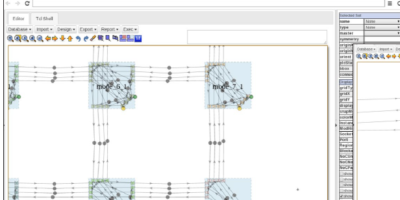
Using automated topology generation for mesh, ring and torus networks, the FlexNoC 4 AI enables SoC architects to generate AI topologies automatically and also edit generated topologies to optimise each individual network router, if desired.

The FlexNoC 4 AI intelligent multicast optimises the use of on-chip and off-chip bandwidth by broadcasting data as close to network targets as possible. This allows for more efficient updates of DNN weights, image maps and other multicast data.

Another feature, source synchronous communications, helps avoid clock tree synthesis, physical placement, and timing closure problems when spanning long distances on AI chips, which can be larger than 400mm2.

The VC-Link virtual channels allow long physical links to be shared in congested areas of the die while maintaining quality of service (QoS).

There is also support for HBM2 and multichannel memory and for up to 2048-bit wide data.

The FlexNoC 4 interconnect IP and the FlexNoC 4 AI Package are available immediately.

Arteris IP provides network in chip (NoC) interconnect IP to accelerate SoC semiconductor assembly for a range of applications from artificial intelligence (AI) to automobiles, mobile phones, IoT, cameras, SSD controllers, and servers. Its customer base include Samsung, Huawei, HiSilicon, Mobileye and Texas Instruments. The IP product line can help customers obtain lower power, higher performance, more efficient design reuse and faster SoC development, to lower development and production costs.

http://www.arteris.com

> Read More

USB multi-function environmental sensor for the IoT

Omron Electronic Components Europe has launched a USB version of its multi-function environmental sensor that quickly allows designers to monitor seven parameters.

Like the previously available Omron 2JCIE-BL01 sensor, the new 2JCIE-BU01 offers multiple sensors in one unit that has built-in memory and connectivity through beacon communication.

Omron’s environmental sensor is available for the first time as a USB unit measuring just 14.9 x 29.1 x 7.0mm and can monitor temperature, humidity, light, UV, barometric pressure, noise, seismic and air quality (VOC gas).

The sensor can accumulate data for approxmately three months (based on a communication frequency of once every five minutes) and connect to multiple devices, such as smartphones, via Bluetooth 5.0.

Despite their compact size, the 2JCIE sensors feature their own embedded memory for data logging to keep track of the surroundings.  Potential applications include monitoring and controlling industrial and office environments to improve work space. It is also suitable for home and outdoor applications.

Data from the modules can be downloaded over Bluetooth (BTLE) allowing designers to easily access recorded data.  The 2JCIE environmental sensors are cloud compatible with no need for additional hardware.  Bespoke threshold values can be set to provide alerts that notify the user of any abnormal sensor readings.

“Our multi-purpose environmental sensors make it easy for the designer to deliver a range of measurement functions from just one small sensor,” said Gabriele Fulco, European product marketing manager, Omron Electronic Components Europe. “This will save development time by providing numerous options that can be tailored to the user’s needs.  he USB version offers even more convenience to suit every application.  Whether it’s a question of simply making sure the office environment is kept at the optimum working temperature or ensuring that say a museum has the correct humidity and lighting to protect the exhibits, these sensors offer easy to interpret data that can then be analysed, stored on the cloud and used to set parameters and make real-time adjustments.”

Certified for all required regulations/directives in the EU, US and Japan, the 2JCIE range is FCC approved and CE marked.

The BTLE link has a range of approximately 10m and the sensor has an operating temperature between -10 and 60 degrees Celsius.

http://components.omron.eu

> Read More

Intel leverages Stratix FPGAs to accelerate data centre computing

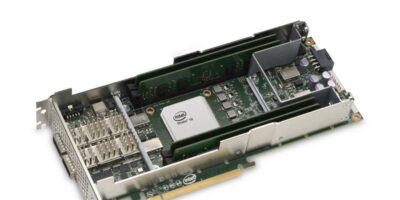
Intel has added the Intel Programmable Acceleration Card (PAC) with its most powerful FPGA, the Intel Stratix 10 SX FPGA. The high-bandwidth card leverages the Acceleration Stack for Intel Xeon CPU with FPGAs, allowing data centre developers to deploy FPGA-based accelerated workloads.

Following on from the earlier Intel PAC with Intel Arria 10 FPGA, the Intel PAC with Stratix 10 SX FPGA supports an ecosystem of design partners that delivers IP to accelerate a range of application workloads.

The Intel PAC with Stratix 10 SX FPGA is a larger form factor card built for inline processing and memory-intensive workloads, like streaming analytics and video transcoding. (The smaller form factor Intel PAC with Arria 10 FPGA is designed for back testing, data base acceleration and image processing workloads.)

It has been developed in response to increasing demands for big data and artificial intelligence (AI) increase, necessitating the reprogrammable technology of the FPGA to meet the processing requirements and changing workloads of data centre applications. The FPGA’s reconfigurable logic, memory and DSP blocks, mean that it can be programmed to execute any type of function with high throughput and real-time performance, making them, claims Intel, ideal for many critical enterprise and cloud applications.

The acceleration stack for Intel Xeon CPU with Intel FPGAs works with industry-leading OS, virtualisation and orchestration software partners, providing a common interface for software developers to get simplified management and access to a growing ecosystem of acceleration workloads.

The Intel PAC with Stratix 10 SX FPGA includes a production-grade FPGA interface manager (FIM) to which Intel and partner AFUs are connected. There is also an acceleration stack for Intel Xeon CPU with FPGAs, including a common set of application programming interfaces (APIs) and open-source drivers and support for native, network-attached workloads. Initial partners include Adaptive Microware and Megh Computing.

It was announced that Hewlett Packard Enterprise will be the first OEM to incorporate the Intel PAC with Stratix 10 SX FPGA along with the Intel Acceleration Stack for Intel Xeon Scalable processor with FPGAs into its server offering.

http://www.intel.com

> Read More

Rutronik adds ‘fastest’ time-of-flight sensor from STMicroelectronics

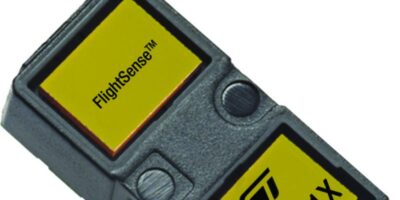
The VL53L1CXV0FY/1 from STMicroelectronics is claimed to be the fastest, miniature time-of-flight (ToF), laser-ranging sensor. It joins the FlightSense and is now available from Rutronik. It has long-distance accurate ranging up to four metres and fast ranging frequency up to 50Hz.

The VL53L1CXV0FY/1 is particularly well suited for applications where user detection is required, e.g. smart home and smart lighting in target applications such as autonomous devices like service robots, drones, smart shelves and vending machines as well as gesture recognition and laser-assisted autofocus systems.

The sensor’s dimensions are 4.9 x 2.5 x 1.56mm. The VL53L1CXV0FY/1 sensor integrates a SPAD receiving array, a 940nm invisible Class1 laser emitter, physical infra red filters, and optics to achieve the best ranging performance in various ambient lighting conditions with a range of cover window options. Unlike conventional IR sensors, the VL53L1CXV0FY/1 uses ST’s latest generation ToF technology that allows absolute distance measurement whatever the target colour and reflectance, explains Rutronik.

It is possible to program the size of the region-of-interest on the receiving array, allowing the sensor field-of-view of 27 degrees to be customised. Setting a specific region of interest position can provide multi-zone operation control from the host. Additionally, the VL53L1CXV0FY/1 is pin-to-pin compatible with the VL53L0X FlightSense ranging sensor.

The VL53L1CXV0FY/1 can be hidden behind a selection of cover window materials and colours allowing designers to integrate them creatively into devices. The sensor provides a standard two-wire I²C interface with up to 400kHz and works with a single power supply (2v8).

For a fast design-in process, ST offers a software driver and code examples for turnkey ranging.

Rutronik UK operates as an independent company with a team of highly qualified employees with broad experience of the electronics industry. Parent company Rutronik Elektronische Bauelemente GmbH is one of the leading broadline distributors for semiconductors, passive and electromechanical components as well as storage technologies, displays and boards and wireless products. Rutronik primarily targets automotive, medical, industrial, home appliance, energy and lighting markets.

http://www.rutronik.com

> Read More

About Smart Cities

This news story is brought to you by smartcitieselectronics.com, the specialist site dedicated to delivering information about what’s new in the Smart City Electronics industry, with daily news updates, new products and industry news. To stay up-to-date, register to receive our weekly newsletters and keep yourself informed on the latest technology news and new products from around the globe. Simply click this link to register here: Smart Cities Registration