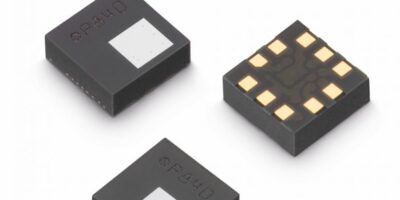

Power amplifier is designed for enterprise small cells

Extending the power amplifiers available from Skyworks, the company has announced the SKY66318-11 high-efficiency power amplifier for infrastructure and small cell applications.

The power amplifier targets the stringent requirements of enterprise small cell applications with wide instantaneous bandwidth (100MHz) and it is fully I/O matched with high gain and efficiency. On-chip active biasing circuitry is also integrated to compensate for power amplifier performance over temperature, voltage, and process variations.

The SKY66318-11 comes in a compact 5.0 x 5.0mm package and operates from a single 5V power supply. It is suitable for use in 4G LTE and 5G NR systems from 3,300 to 3,600MHz.

The SKY66318-11 is also part of major transceiver reference designs. It is part of a high-efficiency, pin-to-pin compatible PA family supporting major 3GPP bands.

Skyworks Solutions says it is empowering the wireless networking revolution, with innovative analogue semiconductors connecting people, places and things spanning a number of applications within the aerospace, automotive, broadband, cellular infrastructure, connected home, industrial, medical, military, smartphone, tablet and wearable markets.

Skyworks has engineering, marketing, operations, sales and support facilities located throughout Asia, Europe and North America.


http://www.skyworksinc.com

> Read More

Module combines sensors for smart building data

Data can be collected within 30 minutes of plugging in the AmbiMate MS4 multi-sensor module. TE Connectivity says that the module collects data for heating, lighting, air quality and other applications to cut time to market for smart building systems.

The AmbiMate MS4 multi-sensor module integrates the most popular set of sensors needed for most smart building solutions. Engineers can use the module instead of up to seven individual sensors, enabling the time required to research, source and integrate multiple sensors and frees up resources to work on other aspects of smart building system designs.

Different module options are available to meet different specifications. A basic version has the four core sensors of passive infra red, ambient light, temperature and humidity to control of heating and lighting. Customers can choose to add a microphone and / or equivalent carbon dioxide and volatile organic compound (VOC) sensors for features such as voice activation and air quality management.

“Engineers face the challenges of looming deadlines, unforeseen technical obstacles and high expectations,” explained Jonathan Catchpole, system architect at TE Connectivity’s industrial business. “We designed the AmbiMate sensor module as the best possible set of sensors for intelligent buildings so that engineers can focus their efforts on . . . cloud integration, software or meeting the WELL Building Standard.”

(The WELL Building Standard is focused on improving comfort and productivity through enhanced control of the environment in and around buildings.)

The AmbiMate sensor module is available to buy as a standalone PCB assembly (PCBA) in bulk and also as a developer kit. The developer kit includes multiple attachment options for flexibility in the mechanical fit and connection inside a product housing. Electronics developers can plug an AmbiMate module into a host controller, like a Raspberry Pi or Arduino device, and start collecting data within 30 minutes with support of code that is available on the company’s website. The module is compatible with the I2C communication protocol.

The AmbiMate sensor module is available from electronics distributors.

http://www.te.com 

> Read More

ZF’s energy harvesting technology has a handle on smart homes

Smart home devices add security and energy efficiency as well as convenience. German door and window handle manufacturer, Hoppe, has developed the eHandle ConnectHome and uses energy harvesting technology from ZF.

The window handle joins the product range as an entry-level model to detect whether a window is open or closed. With ZF’s energy harvesting generator, the RF window handle does not need batteries and can therefore be retro-fitted. Rotating the handle to open or close the window generates enough energy to send an RF signal. The position of the window handle will then be transmitted wirelessly to a central control unit which can be programmed, for example, to automatically regulate the heating to turn down if the windows are open.

The eHandle ConnectHome uses a module consisting of monostable generator and RF board, produced by ZF. The generator is based on an inductive principle meaning that the required RF energy is only generated by the mechanical actuation of the handle incorporating the switch. The data transfer is made wirelessly using the EnOcean RF protocol.

Energy harvesting switches are suitable for various control solutions within different environments and a range of applications, advises ZF.

Founded in 1915, ZF has evolved from a supplier specializing in aviation technology to a global technology company.

It supplies systems for passenger cars, commercial vehicles and industrial technology. It offers integrated solutions for established vehicle manufacturers, mobility providers and start-up companies in the fields of transportation and mobility.

ZF operates in approximately 230 locations in 40 countries.

 https://switches-sensors.zf.com/

> Read More

Absolute pressure sensor delivers calibrated data for navigation

A compact MEMS-based absolute pressure sensor by Würth Elektronik eiSos measures 2.0 x 2.0 x 0.8mm. The Wsen-Pads measures pressure in the range between 26 and 126kPa. Its output data rate can be selected between one and 200Hz. The sensor contains an ASIC and a temperature sensor. This means the output values are already calibrated.

The Wsen-Pads absolute pressure sensor offers the possibility of preparing the measured data for various applications using integrated algorithms that can be activated in such a way that the programming workload for a connected controller is greatly reduced. The measured data can be read out via a standard I²C interface. The I²C interface is extended by an additional interrupt pin whose function can be modified by the user. An application example is using the pressure sensor as an altimeter. The high resolution means the sensor can provide information that enables the position of individual floors in buildings to be mapped for an indoor navigation system. Wsen-Pads is slim, making it suitable for mobile devices. The low power operation means it is possible to supply it with batteries or even energy via energy harvesting.

The piezo resistive sensor is specified for an industrial temperature range from -40 to +85 degrees C. Würth Elektronik also offers a tailored evaluation board.

The sensor is available from stock without a minimum order quantity.

Würth Elektronik eiSos is a manufacturer of electronic and electromechanical components for the electronics industry. The company is one of the largest European manufacturers of passive components and is active in 50 countries. Production sites in Europe, Asia and North America supply a growing number of customers worldwide.

The product range includes EMC components, inductors, transformers, RF components, varistors, capacitors, resistors, quartz crystals, oscillators, power modules, wireless power transfer, LEDs, sensors, connectors, power supply elements, switches, push-buttons, connection technology, fuse holders and solutions for wireless data transmission.

http://www.we-online.com

> Read More

About Smart Cities

This news story is brought to you by smartcitieselectronics.com, the specialist site dedicated to delivering information about what’s new in the Smart City Electronics industry, with daily news updates, new products and industry news. To stay up-to-date, register to receive our weekly newsletters and keep yourself informed on the latest technology news and new products from around the globe. Simply click this link to register here: Smart Cities Registration