
PAN1316C supports BLE and Bluetooth Classic in “RF-unfriendly conditions”

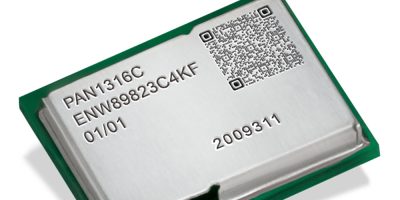
For applications with RF unfriendly housings, Panasonic Industry has introduced the dual-mode PAN1316C module which is an antenna-less variant of its PAN1326C2.

The dual-mode PAN1316C supports Bluetooth Low Energy and Bluetooth Classic and is ready for the connection of an external antenna via bottom pin and is also equipped with the PAN1326C2’s host controlled interface (HCI) Bluetooth radio frequency (RF) module. 

It has been designed to meet the needs of modern device housings to fulfil several criteria at the same time, namely being compact, rugged or waterproof although this might lead to radio waves hitting an impermeable housing structure. To address, this Panasonic Industry offers the PAN1316C “to circumvent a housing’s apparent RF unfriendliness”.

It module has a small footprint of 58.5mm² (9.0 x 6.5 x 1.8mm). It is equipped with the CC2564C Bluetooth core IC from Texas Instruments and is claimed to offer best-in-class performance – about twice the range of other Bluetooth Low Energy solutions. 

In addition to a UART interface, the module contains an audio/voice codec interface which is a dedicated  programmable  serial  port  that  provides  the  logic  to interface  to  several  kinds  of  PCM  or  I2S  codecs. The module has a wide operating temperature range of -40 to +85 degrees C. The supply voltage range is 1.8 to 4.8V. 

The PAN1316C is pin-compatible with previous generations of Texas Instruments-based Bluetooth HCI modules.

The Panasonic Group develops products for consumer electronics, housing, automotive, industry, communications, and energy sectors worldwide.

Panasonic Industry Europe is part of the global Panasonic Group and provides automotive and industrial products and services in Europe. 

The company’s portfolio covers key electronic components, devices and modules and extends to complete solutions and production equipment for manufacturing lines across a broad range of industries. 
http://industry.panasonic.eu

> Read More

LTE-M and NB-IoT module

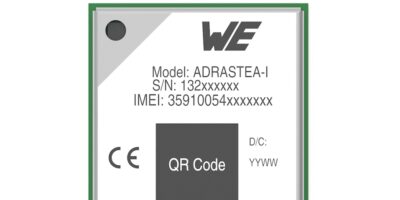
Industrial IoT, connected or smart agriculture, logistics and smart metering applications can use the Adrastea-I module by Würth Elektronik. The  low power, multi-band LTE-M and NB-IoT module measures just 13.4 x 14.6 x 1.85mm but integrates GNSS, an Arm Cortex M4 and 1Mbyte flash memory which is reserved for user application development. 

The module is based on the Sony Altair ALT1250 chipset. Certified by Deutsche Telekom, the Adrastea-I module can be quickly integrated into end products without additional labels, industry-specific certifications (GCF) and operator approvals whenever a Deutsche Telekom IoT connectivity (SIM card) is used.

The Adrastea-I module has multi-band support and can be operated through one of two cellular communication technologies (LTE-M and NB-IoT). This enables the support for international, multi-regional coverage. For example, wherever LTE-M does not have coverage, the Adrastea-I can be configured to use NB-IoT instead, and vice versa. The module is 3GPP Release-13-compliant, upgradable to Release-14. Adrastea-I module is optimised for low power consumption and enhanced coverage. Its small dimensions make it suitable for size-constrained applications such as wearables.

The Adrastea-I module has integrated GNSS, supporting both GPS and GLONASS satellite systems. Integrated GNSS make it suitable for asset tracking applications where infrequent position updates are required.

The Adrastea-I module’s integrated Arm Cortex M4 microcontroller, 1Mbyte flash and 256Kbyte RAM are available exclusively for customer application development.

Sony Altair provides a software development kit (SDK), sample code examples, documentation and tools to accelerate innovation and product development on the integrated Arm Cortex M4 microcontroller.

Deutsche Telekom has certified the Adrastea-I module for multiple European LTE-M and NB-IoT networks. Würth Elektronik eiSos maintains a partnership with Deutsche Telekom IoT for Connectivity (IoT SIM card). The certification confirms that end-products using the Adrastea-I module will interoperate properly on Deutsche Telekom’s various networks.

The Adrastea-I module and its evaluation kit are available in stock now, confirmed Ravindra Singh, product manager, at Würth Elektronik eiSos.

http://www.we-online.com

> Read More

Robust, compact M12 adapter simplifies retrofits in transport

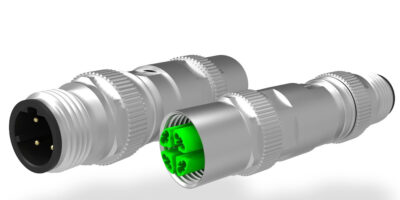
Equipped with X to D and D to X coding, the compact M12 adapter released by Provertha is designed to simplify retrofitting in transportation and railway technology.

It allows an M12 plug in connection with X to D and D to X coding to be made without any additional effort, said the company. A full metal housing provides shielding for the adapter which features an X- or D-coded pin interface with a rotating screw lock and a D- or X-coded socket interface with a fixed locking thread. The adapters are simply inserted between the switch and the cable using the usual torque tools. 

According to Provertha, this M12 adapter make a significant contribution to saving cabling costs and installation time. Rated to IP 67, it can be used for data transmission of up to 100Mbit and operates across a wide temperature range of -25 to +85 degrees C.

An X to D-coded adapter is particularly advantageous for retrofitting in railway technology, said Provertha, as existing D-coded cabling can continue to be used, even if the switches have to be replaced by gigabit port switches during overhauls. Equally, the X to D-coded adapter allows 100Mbit devices to be connected with Gigabit cabling systems.

Typically, Ethernet capable devices, which need no Gbit Ethernet, are equipped with M12 D-code connecters while newly installed Ethernet cablings are already based on X-code technique (using four pairs).

Ethernet switches are used for data communication in trains and infotainment in train carriages. The trend towards higher data rates is also applicable to railway switches. As equipment is overhauled, old switches are increasingly replaced, for example, 100Mbit ports on the switches are increasingly being replaced by Gbit ones. This means that instead of the D-coded M12 sockets, more X-coded sockets will be used despite D-coded cabling being retained because of the high cost of the X-coded cables, requiring D-coded connectors that can match X-coded sockets.

http://www.provertha.com

> Read More

Lama small dual-band antenna servers EU and US networks

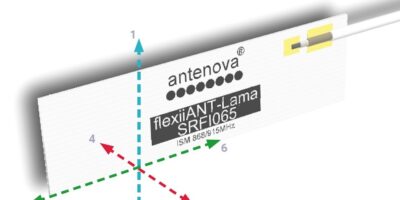
Able to operate in both Europe’s 868 MHz bands and the US 915 MHz bands, Lama is a small, dual-band antenna from Antenova. 

The Lama (part number SRFI065) was developed for small, connected devices operating on the LP-WAN networks including LoRa, Sigfox, Wi-SUN and MIoTy. It uses the ISM (industrial, scientific and medical) frequencies in Europe and America or both, which means that one product design can be sold in both US and European markets. 

The Lama antenna is suitable for small, networked devices operating across wide geographic areas in IoT applications, especially in smart agriculture, smart cities and tracking, advised Antenova. 

The small antenna is suitable for designs where real estate is limited. The flexible printed circuit (FPC) antenna measures 35 x 10 x 0.1 mm and is supplied with a standard 100mm RF cable with I-PEX MHF connector. This shape allows it to be mounted several different ways in a design.

The antenna performed equally well in tests for the 868 and 915MHz bands, reported Antenova, showing a peak efficiency at 60 per cent and maximum VSWR (voltage standing wave ratio) of 1.5:1 for both frequency bands.

The LP-WAN networks, also known as ISM, use frequencies 863 to 870MHz in Europe and 902 to 928MHz in the US. They are licence-free bands which are typically used to connect large fleets of low powered devices which transmit small packets of data across large physical distances at low bit rates.

Typical agricultural application examples are those using cloud-connected sensors to measure ground moisture or temperature or to track livestock, e.g. cattle.

In smart cities it is suitable for remote-controlled applications such as meter reading, environmental monitoring and connected services, controlling street lighting, parking sensors or waste bins.

In other IoT sectors, the Lama antenna fits commercial applications in cold chain transport, distribution, logistics and tracking of goods and containers. 

Antenova’s Michael Castle commented: “The Lama antenna targets . . . growing markets which will need large volumes of devices on all continents of the world. For example, we estimate there could be 45 million connected street lights worldwide by 2025.”

Antenova provides consultancy and testing services and a selection of online tools and calculators to help designers achieve a successful integration and a high performance wireless device. 

http://www.antenova.com

> Read More

About Smart Cities

This news story is brought to you by smartcitieselectronics.com, the specialist site dedicated to delivering information about what’s new in the Smart City Electronics industry, with daily news updates, new products and industry news. To stay up-to-date, register to receive our weekly newsletters and keep yourself informed on the latest technology news and new products from around the globe. Simply click this link to register here: Smart Cities Registration