
Low-cost trackers are compatible with Abeeway LoRaWAN tags

An inexpensive tracking device has been developed by Troverlo, Actility, and its subsidiary Abeeway. The Troverlo host powered tag can be read by Abeeway LoRaWAN(long range wide area network) trackers.

The integrated tag, powered by location tracking and data collection service provider, Troverlo, enables customers track assets that may not have been feasible to track due to cost, said the company. 

The Troverlo tags use a standard Wi-Fi chip to send out a beacon, similar to a Wi-Fi access point, that can be picked up by any device looking for a Wi-Fi connection. Due to built-in Wi-Fi sniffing capabilities, they work seamlessly with Abeeway LoRaWAN trackers. The Abeeway tracker “sees” Troverlo tags and reports their location and sensor data through the connected LoRaWAN gateway and ThinkParkX Location Engine. Troverlo tags only require a standard off-the-shelf Wi-Fi chip to be effective, said Actility, and are therefore available in different form factors, from standalone battery powered tags to embedded tags built into equipment or products.

The Troverlo tags are automatically tracked outside of LoRaWAN connectivity through the Troverlo Global Observation Network. This means if a tracked asset leaves the LoRaWAN area, it will be tracked anywhere on the globe without any additional connectivity required. Troverlo’s Global Observation Network consists of connected devices like cell phones, Wi-Fi access points, and telematic nodes.  Compared to other connection methods, like LTE, Troverlo tags can be tracked for one tenth the price, said Agility.

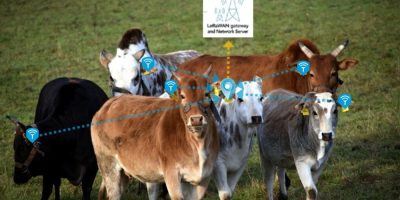
The Troverlo / Abeeway tracking tag can be applied across any Actility implementation, including livestock management, where it is used to monitor abnormal behaviour or locations. However, with relatively low margins not all ranchers can afford to track each animal. Troverlo tags allow farmers or ranchers to track each animal and use the existing Abeeway trackers to backhaul the data.

Other application areas are in logistics and transportation. The inexpensive Troverlo tags can be attached to every pallet or product being shipped for it to be tracked as it moves from the warehouse, to the truck, to the customer site. Troverlo tags enable Abeeway fleet management to scale into more granular tracking of product movement, added Actility.
https://www.actility.com

> Read More

Pluggable transceiver module provides optical GbE in vehicles

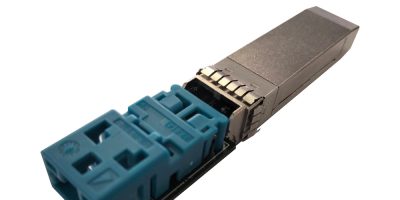
KDPOF has developed and validated the first 1000BASE-RH SFP module for optical Gbit connectivity in vehicles. The small form factor pluggable (SFP) transceiver module is based on a standard SFP supporting multi-source agreement registers via I2C bus. The module can operate at 100 and 1,000Mbit per second. It integrates the whole 1000BASE-RHC PHY and the header connector for SI-POF optical harness. 

The SFP module has been tested and validated in a functional demo. According to Carlos Pardo, CEO and co-founder of KDPOF, who described it as the first milestone for future commercial optical 1000BASE-RH SFP modules, for integration into the optical ecosystem in automotives. 

The SFP supports 1000BASE-X, 100BASE-X, and SGMII (with and without auto-negotiation) as electrical interfaces. It monitors the received optical power, the link margin, the junction temperature, and the supply voltages, among others.

The SFP design has been sampled and validated. KDPOF and Ethernet network testing and visibility tool company, Aukua Systems, are collaborating to optimise the 1000BASE-RHC SFP and make it available in Q3 2022.

Fabless semiconductor supplier KDPOF provides high speed optical networking for harsh environments. Making Gbit communications over fibre optics a reality, KDPOF technology supplies 1Gbit per second POF links for automotive, industrial, and home networks. KDPOF was founded in 2010 in Madrid, Spain, and offers technology as either ASSP or intellectual property (IP) to be integrated in SoCs. The adaptive system works with a range of optoelectronics and low cost large core optical fibres, which provide carmakers low risk, low cost and short time-to-market, claimed the company.

https://www.kdpof.com

> Read More

Bluetooth LE module goes where radios aren’t welcome

A Bluetooth 5 Low Energy module for applications deemed “radio-unfavourable” has been introduced by Panasonic. 

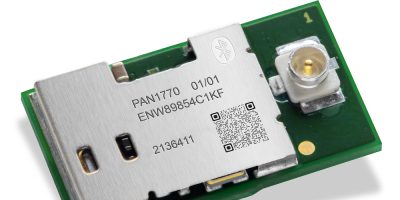
The PAN1770 Bluetooth 5 Low Energy (LE) module includes a uFL connector which enables the use of an external antenna for use where difficult housing conditions shield radio waves. 

“We have seen that in many devices or applications, radio waves emitted by the chip antenna can be blocked or reflected by the metallic housing, making it difficult to receive the radio signal from the outside”, commented Tomislav Tipura from Panasonic Industry Europe. Using the PAN1770 module, an external antenna can easily be attached via the uFL connector and thus redirect the radio waves outside the housing, he explained.

The module is based on Nordic Semiconductor’s nRF52840 single chip controller. It joins the PAN1780 Bluetooth 5 module from Panasonic. 

Output power is up to 8dBm. The module is suitable for use in applications where a long range is required, due to the sensitivity of 95dBm at 1.0Mbits per second and -103dBm at 125kbits per second via the nRF52840 chip controller combined with the LE coded PHY, said Panasonic. Current consumption is just 4.8mA in Tx (at 0dBm), 4.8mA in Rx mode, 0.4 microA in system off mode and around 0.7 microA with RTC wake-up. These parameters make the module suitable for used in a battery-powered device. 

It also includes a Cortex M4F processor, 256kbyte RAM and built-in 1.0Mbyte flash memory. The device can be used in standalone mode, eliminating the need for an external processor, while reducing complexity, lowering costs and saving space, said the company. The PAN1770 module also supports Type 2 near field communication (NFC A) for use in simplified pairing and payment systems, although an external antenna is required.

The module has a small footprint of 15.6 x 8.7 x 1.8mm. Maximum output power is 8dBm, configurable from -20dBm in 4.0dB steps and -40dBm in whisper mode. For 802.15.4 support, it has Matter, Zigbee and Thread, as well as up to 48 programmable general purpose I/Os and SPI, I2C, UART, PWM, ADC, NFC, USB2.0 interfaces.

http://industry.panasonic.eu

> Read More

Smart watch and LoRaWAN monitor patients’ safety

French management group, Domitys has installed a private LoRaWAN (long range wide area network) in one of its residences in Mauritius where patients wearing smart watches by Life Plus, a provider of support and remote patient monitoring systems..

Unlike projects in France where there is a public LoRaWAN available, in Mauritius it was necessary to create a private LoRaWAN bubble to ensure coverage of our apartment building and its surroundings. 

Using Actility’s ThingPark Enterprise IoT platform, Life Plus deployed a private LoRaWAN to cover the whole facility which consists of two buildings with 120 two or three room apartments. Eight gateways have been installed, six indoors and two outdoors, as part of a network which covers all apartments, lifts and surrounding outdoor areas. The project created a 10km wide network around the residence.

Most of the currently available devices were found to be only for raising assistance (SOS and falls) and were deemed to be stigmatising and with a low use rate.

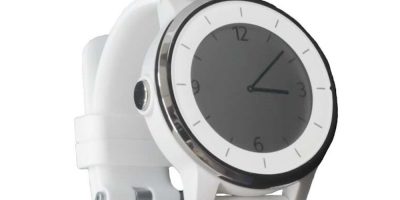
At this facility in Mauritius, Domitys wanted to make sure the residents were secure while helping to maintain their autonomy. They wear a smart watch which alerts staff as soon as something goes wrong (such as a fall or unusual activity) or if the resident sends an SOS. The smart watch is customisable to fit preferences, such as a dial, bracelet, display design.

Life Plus co-creates products with real users – seniors, caregivers, geriatricians, general practitioners, physiotherapists, dietitians and neuropsychologists, allowing it to develop an easy to use device with a customisable design that is used by 87 per cent of residents every day.

Within the facility, small beacons are placed in apartments and shared areas, for the system to precisely locate residents inside the building, in a non-intrusive way, and only in case of problems. Bluetooth location beacons do not require wiring and are battery operated. This therefore brings flexibility in their positioning in all rooms and in the hotel park, and the most discreet integration possible.

The smart watch uses Dona Care, a cloud data and software service. The personalised smart watch and digital platform also provides customised coaching and automatic data transmission such as activity and health monitoring.

Residents are motivated to exercise more thanks to a personalised coaching focused on physical activity: walking and active walking durations, number of steps, and a daily walking goal that can be set up, pushing them to achieve it. This program can be extended to cognition activities and nutrition advice too, to support caregivers and help maintain autonomy.

A ThingPark Market demo kit is now available for purchase powered by Actility.

https://www.actility.com

> Read More

About Smart Cities

This news story is brought to you by smartcitieselectronics.com, the specialist site dedicated to delivering information about what’s new in the Smart City Electronics industry, with daily news updates, new products and industry news. To stay up-to-date, register to receive our weekly newsletters and keep yourself informed on the latest technology news and new products from around the globe. Simply click this link to register here: Smart Cities Registration