
ULIS claims “world’s smallest thermal image sensor”

For small thermal cameras, ULIS is presenting the ATT0640 at the SPIE Defence and Commercial Sensing show in Baltimore, Maryland, USA (14 to 18 April).

It is claimed to be the world’s smallest 60Hz VGA/12 micron thermal image sensor and enables the use of smaller thermal cameras with extended battery autonomy in portable equipment for commercial and defence applications.

The sensor can be used in thermal weapon sights (TWS), surveillance and handheld thermography cameras, as well as personal vision systems (PVS), including portable monoculars and binoculars for consumer outdoor leisure, law enforcement and border control.

The PVS segment alone, is expected to see annual unit growth of 30 per cent between 2018 to 2024 (according Yole Developpement: Uncooled Infrared Imagers and Detectors 2019).

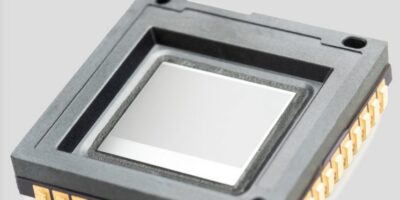
The Atto640 measures 16.5 x 16.5mm and is designed to address the size, weight and power (SWaP) reduction requirements across commercial and defence thermal image applications.

The surface mount VGA format device joins the existing QVGA Atto320 to give camera manufacturers more choice in the company’s 12 micron product range. ULIS adds that compared to 17 micron pixel pitch technology, the 12 micron pitch enables them to use smaller and lower cost optics.

Atto640 uses wager level packaging (WLP) to achieve the size advantage, describing this technology, in which the detector window is directly bonded to the wafer, as enabling a significant reduction in the overall dimension of the sensor.

The footprint of the Atto640 footprint is half the size of ULIS’ Pico640-046 (17 micron) model. The WLP enables a batch-processing technique and is suited to high-volume production.

Samples of Atto640 are currently available, with production ramp-up slated for the end of 2019. ULIS intends to further extend its 12 micron product line up with larger resolution sensors.

ULIS is a subsidiary of Sofradir. It designs and manufactures thermal image sensors for commercial, defence and security applications. Established in 2002, ULIS claims to be the world’s second largest producer of thermal image sensors (microbolometers), exporting 97 per cent of its products to camera makers across Europe, Asia and North America.

ULIS products range from low-resolution to megapixel military-grade sensors. They are used to detect threats, diagnose heat loss, avoid road obstacles, perform air-to air refuelling, locate search and rescue victims and observe nature.
http://www.ulis-ir.com

> Read More

Rohde & Schwarz provides test package for C-V2X protocol

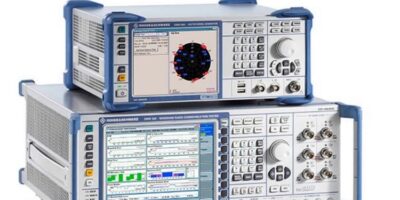
Approval for Rohde & Schwarz’s cellular vehicle-to-everything (C-V2X) protocol conformance testing package, reassures customers that it fulfils the specification defined by the Global Certification Forum (GCF). The approval is based on tests executed using the CMW500 wideband radio communication tester and SMBV100A vector signal generator.

The GCF certifies the conformance of cellular handsets to ensure that handsets operate as specified with the wide range of base station hardware installed by network operators.

The organisation announced the inclusion of cellular (LTE) based vehicle-to-everything (V2X) and vehicle-to-vehicle (V2V) communication technologies within its certification program. This certification focuses specifically on LTE sidelink, an adaptation of core LTE standards (as defined in 3GPP Release 14) that allows communication between two or more nearby devices. It can be provided on any LTE band with the 5.9 GHz band allocated for intelligent transport system (ITS) services.

Rohde & Schwarz believes it is the first test and measurement equipment manufacturer to meet the GCF test platform approval criteria (TPAC) for C-V2V protocol conformance testing.

On the wireless communication side, the CMW500 wideband radio communication tester supports both LTE-A and WCDMA/HSPA+ technologies as well as performing LTE sidelink functionality testing on the communication link to the C-V2X module. It can be used in conjunction with the SMBV100A vector signal generator, which simulates the GNSS signals of global positioning services such as GPS, GLONASS, Galileo, and BeiDou. Implementation of the GCF-approved protocol tests are provided through the CMW-KK550 software package.

Rohde & Schwarz supports developers and engineers that are new to automotive C-V2X module testing and enables existing customers and test houses to leverage existing hardware to support C-V2X compliance testing through a simple software upgrade.

This news story is brought to you by softei.com, the specialist site dedicated to delivering information about what’s new in the electronics industry, with daily news updates, new products and industry news.

To stay up-to-date, register to receive our weekly newsletters and keep informed of the latest technology news and new products from around the globe. Simply click this link to register here:  softei.com

http://www.rohde-schwarz.com

> Read More

Mini media converter is robust for security and transport applications

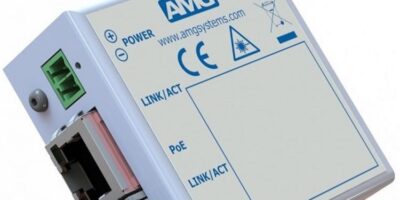
Mini media converters connect field-based equipment to Ethernet networks over long distances via fibre. The small form factor of the 9HMEC mini media converters mean they are small enough to be installed in the confined spaces provided by camera poles and street cabinets, and tough enough to operate in temperatures ranging from -40 to 70 degrees C, says AMG Systems.

The converters are rugged enough to withstand security and transport camera and device installations. They provide a 100Mbits per second or Gigabit Ethernet uplink across fibre via the SFP port, providing a hardened means of converting IP signals for transport over long distances across all types of fibre cabling. It is also cost-effective, says AMG.

Target applications are CCTV system is used for security applications, where it is essential that the video signal delivery. Another use is transport applications, which use monitoring cameras and critical signage.

The Mini media converters are DIN rail-mountable, so can be quickly installed and removed for maintenance. They are non-programmable so there is no need for any user configuration or computer-based set-up.

The converters offer an optional link fault forwarding (LFF) feature, which allows a pair of media converters to share their link status. Any associated subsequent copper or fibre link failure will result in both linked media converters disabling the copper links, ensuring that attached networking devices recognise the Link Fail status and thus do not forward data into what would otherwise be a data cul-de-sac.

AMG is a UK manufacturer, providing environmentally robust fibre, analogue, IP/Ethernet, wireless and hybrid communication transmission products. It can design and build a bespoke transmission system for a highly specialist application or manufacturing a complete range of ruggedised and hardened industrial Ethernet switches for the CCTV industry.

This news story is brought to you by softei.com, the specialist site dedicated to delivering information about what’s new in the electronics industry, with daily news updates, new products and industry news.

To stay up-to-date, register to receive our weekly newsletters and keep informed of the latest technology news and new products from around the globe. Simply click this link to register here:  softei.com

http://www.amgsystems.com

> Read More

eGaN FET family expands to include 3.8 milliOhm device

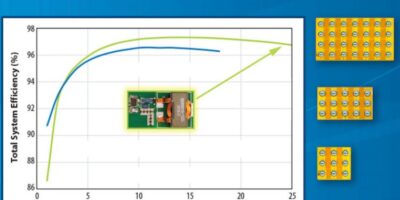
Efficient Power Conversion (EPC) has expanded it 100V eGaN® FET family, with the addition of the EPC2053. The 100V 3.8 milliOhm eGaN FET joins the EPC2045, EPC2052 and EPC2051 100V eGaN FETs.

The family is designed to offer 100V products suitable for a wide-range of power levels and price points to meet the increasing demands of 48V server, 48V automotive, and 54V data centre applications. The eGaN FET family includes single-stage 48V to load open rack server architectures, USB-C, precision motor drives, LED lighting, and lidar.

According to EPC, the latest generation of 100V GaN devices increase the efficiency, shrink the size, and reduce system cost for 48V power conversion.

GaN can be specified in artificial intelligence (AI), cloud computing, and advanced high-performance motor drives. In the automotive market, systems are moving from 12V distribution systems to 48V systems as autonomous vehicles integrate lidar, radar, camera, and ultrasonic sensors.

EPC adds that in all the topologies with 48V IN, the highest efficiency is obtained using GaN devices due to their lower capacitance and smaller size.

EPC believes that recent pricing decreases in GaN power transistors mean that the cost comparison with equivalent silicon-based converters “strongly favours the use of GaN devices in all leading-edge solutions”.

Two reference designs and five demonstration boards are available, including the EPC9138 demonstration board is a 400kHz switching frequency, 48V IN, 15A output current, buck converter featuring the 100V EPC2053. The EPC9141 demonstration board is a 400kHz switching frequency, 48V IN, 10A output current, buck converter featuring the 100V EPC2045.

Standard half-bridge development boards available to support easy in-circuit performance evaluation of each of the 100V family devices. The EPC9093 supports the EPC2053, the EPC9078 and EPC9205 support the EPC2045, the EPC9092 supports the EPC2052 and the EPC9091 supports the EPC2051.

All products and boards are available for order from Digi-Key.

http://www.epc-co.com

> Read More

About Smart Cities

This news story is brought to you by smartcitieselectronics.com, the specialist site dedicated to delivering information about what’s new in the Smart City Electronics industry, with daily news updates, new products and industry news. To stay up-to-date, register to receive our weekly newsletters and keep yourself informed on the latest technology news and new products from around the globe. Simply click this link to register here: Smart Cities Registration