
TI expands MCU portfolio and software ecosystem to enable edge AI in every device

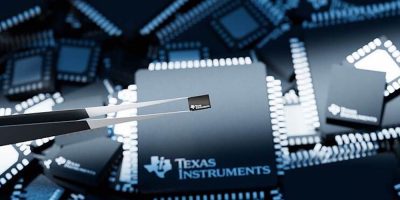
Texas Instruments has introduced two new microcontroller (MCU) families with edge artificial intelligence (AI) capabilities, supporting the company’s commitment to enabling edge AI across its entire embedded processing portfolio. The MSPM0G5187 and AM13Ex MCUs integrate TI’s TinyEngine neural processing unit (NPU), a dedicated hardware accelerator for MCUs that optimises deep learning inference operations to reduce latency and improve energy efficiency when processing at the edge.

TI’s embedded processing portfolio is supported by a development ecosystem, including the CCStudio integrated development environment (IDE). Its generative AI features allow engineers to use simple language to accelerate code development, system configuration and debugging through industry-standard agents and models paired with TI data. Altogether, TI is accelerating the adoption of edge AI in any electronic device, from real-time monitoring in wearable health monitors and home circuit breakers to physical AI in humanoid robots. These end-to-end innovations are featured in TI’s booth at embedded world 2026, March 10-12, in Nuremberg, Germany.

Consumers are always looking for everyday technology to be more intelligent, from fitness wearables to home appliances and electrical systems. However, many engineers believe that AI capabilities are exclusive to higher-end applications given high costs, power demands and coding requirements. TI’s new MSPM0G5187 Arm Cortex-M0+ MSPM0 MCU represents a fundamental shift for embedded designers, who can now bring edge AI to a wide range of simpler, smaller and more cost-effective applications.

With local computation, the TinyEngine NPU executes computations required by neural networks in parallel to the primary CPU running application code. Compared to similar MCUs without an accelerator, this hardware acceleration:
• Minimises the flash memory footprint.
• Lowers latency by up to 90 times per AI inference.
• Reduces energy utilisation by more than 120 times per AI inference.

Motor control applications in appliances, robotics and industrial systems increasingly call for intelligent features such as adaptive control and predictive maintenance, but implementing these capabilities has historically required complex, multi-chip designs. TI’s new AM13Ex MCUs are the industry’s first to integrate a high-performance Arm Cortex-M33 core, TinyEngine NPU and advanced real-time control architecture into a single chip.

This degree of integration enables designers to implement sophisticated motor control and AI features simultaneously without external components, lowering bill-of-materials costs by up to 30%. Key enhancements include:
• The ability to maintain precise real-time control loops for up to four motors while the TinyEngine NPU runs adaptive control algorithms for load sensing and energy optimisation.
• An integrated trigonometric math accelerator that performs calculations 10 times faster than coordinate rotation digital computer (CORDIC) implementations, delivering more precise, responsive motor-control performance.

Both MCU families are supported by TI’s CCStudio Edge AI Studio, a free development environment that simplifies model selection, training and deployment across TI’s embedded processing portfolio. This edge AI toolchain gives engineers full flexibility to run AI models on TI MCUs through either hardware or software implementations. Today, there are more than 60 models and application examples available in the tool to help developers start deploying edge AI in any device, with additional tasks and models planned in the future.
www.ti.com

> Read More

NXP’s new i.MX 93W fuses edge compute and secure wireless connectivity

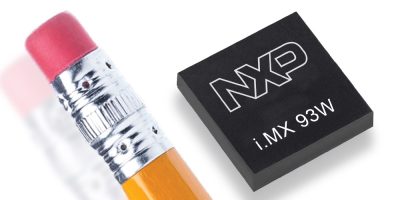
NXP Semiconductors has announced the i.MX 93W applications processor, expanding NXP’s i.MX 93 family. Purpose-built to accelerate physical AI deployment, the i.MX 93W SoC is the industry’s first applications processor to combine a dedicated AI neural processing unit (NPU) with secure tri-radio wireless connectivity. This high degree of integration allows customers to replace up to 60 discrete components with a single package. Pre-certified reference designs eliminate many common integration challenges, reducing the complexity, cost and risk traditionally associated with RF design. Supported by NXP’s software and industry-leading eIQ AI enablement solutions, the i.MX 93W also supports smaller form factors and is designed to accelerate time-to-market for physical AI applications.

Physical AI requires coordinated AI agents to collaborate locally, taking real-time action with low latency and high reliability. For example, AI agents might coordinate across a smart building’s lighting, HVAC, access control, occupancy and smart energy systems to autonomously optimise comfort, energy efficiency, and operational responsiveness securely in real time.

NXP’s new i.MX 93W addresses this need by integrating scalable edge compute, AI acceleration, and secure wireless connectivity in a single package, supported by NXP’s software, eIQ AI enablement and pre-certified reference designs. This allows coordinated AI agents to locally manage physical environments, such as a group of healthcare agents working together to coordinate wearables, smart diagnostics, sensors and health gateways that deliver real-time healthcare insights and actions. The highly integrated i.MX 93W SoC also allows customers to rapidly scale physical AI across healthcare devices, smart building controllers, industrial gateways, energy infrastructure monitors and smart home hubs.

The i.MX 93W applications processor combines a dedicated AI NPU with secure tri-radio wireless connectivity in a single package. This eliminates the need for up to 60 discrete components, significantly reducing board area, design and supply chain complexity and system-level costs. The i.MX 93W features a dual-core Arm CortexA55 applications processor with a dedicated Arm Ethos NPU capable of up to 1.8 eTOPs. The integrated IW610 tri-radio combines Wi-Fi 6, Bluetooth Low Energy, and 802.15.4 connectivity supporting Matter and Thread deployments. This eliminates complex RF tuning steps and coexistence challenges that traditionally slow development and certification, speeding time-to-market.

The i.MX 93W SoC integrates an EdgeLock Secure Enclave (Advanced Profile), addressing regulatory requirements, including European Cyber Resilience Act (CRA). The embedded EdgeLock Secure Enclave is a hardware root of trust simplifying implementation of security-critical functions like secure boot, secure update, device attestation and secure device access. Combined with NXP’s EdgeLock 2GO key management services, OEMs can securely provision i.MX 93W SoC-based products at device manufacturing or in the field.

NXP’s pre-certified i.MX 93W SoC-based single and dual-antenna reference designs minimise RF tuning effort and eliminating many common integration challenges. Certified across multiple countries and regions, these reference designs reduce the complexity, cost and risk traditionally associated with RF design and wireless certification. By leveraging validated antenna options and pre-approved designs, customers can shorten regulatory approval timelines, reduce development cost, and bring products to market faster.

nxp.com

> Read More

u-blox announces new dual-antenna, all-band GNSS heading module

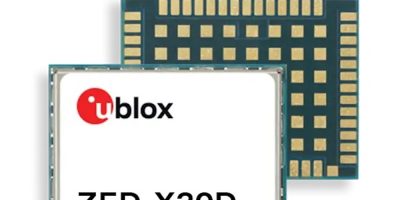
u-blox has announced the launch of its all-band GNSS heading module, the ZED-X20D. Based on the u-blox all-band X20 high precision technology, the ZED-X20D is a breakthrough dual-antenna solution that delivers centimetre-level RTK positioning and precise, motion-independent GNSS-based heading.

The ZED-X20D delivers accurate heading even at standstill and low speeds, enabling more reliable auto-steering, safer autonomous operation, and more predictable behavior in real-world environments.

The compact, energy-efficient ZED-X20D targets industrial applications such as precision agriculture (including auto-steering and guidance systems), Unmanned Aerial Vehicles (agricultural UAVs, delivery UAVs), heavy machinery, marine and robotics navigation. It supports all GNSS constellations on L1, L2, L5, and L6 on both antennas, as well as L-band. This approach maximises heading availability and stability and delivers best-in-class performance in challenging GNSS conditions.

To meet diverse positioning accuracy and deployment needs, the ZED-X20D supports RTK, PPP-RTK, and PPP correction services. Customers can use u-blox PointPerfect to access a portfolio of correction options for regional and global coverage, while built-in support for Galileo E6 enables the free-to-use Galileo High Accuracy Service (HAS).

ZED-X20D, together with the u-blox ANN-MB2 all-band high-precision antenna and u-blox PointPerfect service, forms a ready-to-use all-band GNSS solution delivering centimetre-level positioning with accurate heading, simplifying design, reducing system cost, and accelerating mass adoption

Designed with u-blox end-to-end hardened security, the ZED-X20D protects heading and positioning data from satellite to host. It features secure boot, signed firmware, and a hardware root of trust for cryptographic material, supports Galileo OSNMA, and uses encrypted correction data. All-band frequency diversity and advanced interference monitoring provide robust protection against jamming and other threats, helping end customers maintain trustworthy operation in critical applications.

The ZED-X20D reduces system complexity and on-host processing requirements. Retaining the industry-proven ZED form factor offers an easy upgrade path for existing customers, including users of the ZED-F9P, ZED-F9H and ZED-X20P helping engineers to quickly evaluate, benchmark, and deploy the solution in new or existing designs.

u-blox.com

> Read More

Nordic Semi debuts low-power nRF93M1 Cat 1 bis module at MWC 2026

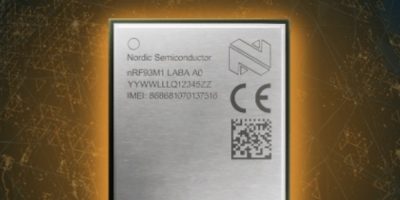
Nordic Semiconductor is demoing the nRF93M1 module with LTE Cat 1 bis connectivity and its associated development kit at MWC 2026. This will be part of Nordic’s suite of additions to its future-ready cellular IoT portfolio.

“nRF93M1 delivers what customers have been asking for – a high‑quality, low-power Cat 1 bis module that’s smaller, easier to integrate, and built for the cloud from day one,” says Oyvind Birkenes, EVP Long-Range at Nordic Semiconductor. “It brings more performance with less complexity, giving developers a powerful, future‑ready platform.”

Bringing LTE Cat 1 bis connectivity to Nordic’s long-range portfolio, the nRF93M1 offers fully compatible regional and global module options for widespread, reliable, scalable IoT deployments. With the nRF54L host MCU reference design, evaluation kit, and open documentation, companies get a much faster development cycle, including quick bring-up, easier integration, and fewer technical barriers when moving from prototype to product. Ultra-low-power features ensure that battery-powered devices operate for years in the field, while standardised, Nordic-optimised interfaces and peripherals make it easy to slot the nRF93M1 into new and existing system designs.

The nRF93M1 is built for flexibility, supporting Wi Fi and cellular eCID location, multiple embedded peripherals, coexistence control, and multiple SIM options, including IoT eSIM (SGP.32) remote provisioning support and low-power SoftSIM. Global and regional regulatory and mobile operator certifications are ongoing to ensure compliance and accelerate time-to-market for customers.

“The nRF93M1 delivers reliable 4G performance with lower device complexity, broad coverage, and power-efficient operation – key advantages for scalable IoT deployments,” says Kristian Sæther, Senior Product Director Long-Range at Nordic Semiconductor. “Combining Nordic’s ease of use with Cat 1 bis connectivity empowers companies to build high‑performing devices today, while we continue to develop a further optimised eRedCap solution as the 5G ecosystem matures.”

The nRF93M1 DK provides a complete out-of-the-box experience for rapid evaluation and prototyping with the nRF93M1 module, the nRF54L host MCU reference design, and the pre-provisioned nRF Cloud services support.

The nRF93M1 will ship with nRF Cloud’s power-optimised cellular and Wi-Fi location services, embedded observability, and firmware OTA capabilities, all built into the modem. It can be activated on the modem via simple AT commands and extended to a Nordic host MCU via integration with the nRF Connect SDK. This combination of production-ready services means easier product development, lower-risk product launches, simpler in-field maintenance, and streamlined scale up.

Together, the nRF93M1, its development kit, and nRF Cloud deliver a low-power, developer-friendly platform for building more data-intensive cellular IoT products.

nordicsemi.com

> Read More

About Smart Cities

This news story is brought to you by smartcitieselectronics.com, the specialist site dedicated to delivering information about what’s new in the Smart City Electronics industry, with daily news updates, new products and industry news. To stay up-to-date, register to receive our weekly newsletters and keep yourself informed on the latest technology news and new products from around the globe. Simply click this link to register here: Smart Cities Registration