
Optical front end IC gives a LiFi boost to any mobile device

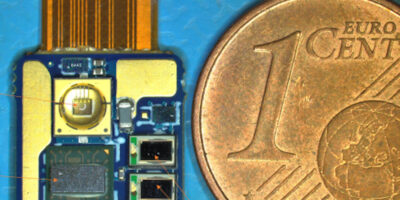
At MWC21, LiFi specialist, Oledcomm, unveiled Gigabit OFE, an ASIC that turns any mobile device into a Li-Fi-powered device, says the company.

Li-Fi (light fidelity) allows devices to be connected to each other using light. Li-Fi transmits data by modulating light signals from a light source, the light signals are received and converted into data using a dongle connected to the device.

The 1.5 x 2.5mm ASIC can be seamlessly integrated into smartphones, laptops and tablets, says the company, eliminating the need for the dongle. It can be coupled with photodiodes and light source like LED or VCSEL to achieve a 1Gbit per second point to point connection at a distance of one to five metres. The OFE can be used with a G.99991 baseband as well as a 802.11 baseband which is already present in most of today’s mobile devices.

Benjamin Azoulay, president of Oledcomm, said the Gigabit OFE will radically change the end user experience. Dongles will no longer be required as the Li-Fi is natively integrated into devices, bringing a “light-based, fast, secure and healthy wireless connectivity anywhere WiFi/4G/5G radio waves are not suitable”.

Oledcomm is based in Paris, France and specialises in data exchange solutions using light (Li-Fi). It designs complete solutions for Li-Fi operation, including microcontrollers (modems), Li-Fi photoreceivers (dongles and bridges) and software platforms (Li-FiCloud and software development kits).

The potential market for Li-Fi is huge, says the company: with 14 billion points of light worldwide which could become a powerful, safe and radio-free communication network.

Oledcomm holds more than 28 patents (supported by France Brevets) and has partnered with Ariane Group, Thales Alenia Space, OneWeb, French space agency CNES and Ford.

In January 2018, Oledcomm launched MyLiFi, the first luminaire accessible to the general public, the following year, it launched the LiFiMAX website, the first internet access point through invisible light.

In October 2019, an Air France A321 plane equipped with Oledcomm Li-Fi modems flew from Paris to Toulouse.

Oledcomm is certified ISO9001 and ISO14001.

http://www.oledcomm.net

> Read More

Transparent antenna fits smartphone screens to reduce disruption

At MWC21, OLED display touch sensor manufacturer, Dongwoo Fine-Chem showcased this transparent, on-display screen mmWave antenna for 5G.

The Antenna on Display (AoD) technology is a transparent antenna designed to deliver the best possible 5G coverage for smartphones and communication infrastructure.

Current 5G smartphones have mmWave antennae built into the side or the back of the device, which often causes interruptions to radio wave transmission and disruptions to 5G stability when users hold the smartphone. An antenna that fits on the smartphone screen reduces disruption, says Dongwoo.

“Technologies like augmented reality (AR) and virtual reality (VR) require mmWave 5G technology that delivers high speed and low latency,” explained Rha In-ho, CEO and president of Dongwoo Fine-Chem.

MmWave operates at 30 to 300GHz and one to 10mm in wavelength, making it particularly well suited to high-speed 5G, while securing a wide bandwidth at the same time. However, mmWave cannot pass most solid materials effectively. Dongwoo Fine-Chem’s AoD technology allows device manufacturers to install a transparent antenna on the display, where it is least likely to be obscured by users for stable mmWave 5G communication with minimal transmission interruptions. It can realise dual polarisation on the three frequencies (n257=26.5 to approximately 29.5GHz, n258=24.25 to approximately 27.5GHz, n260=37 to approximately 40GHz) of mmWave 5G that is most commonly used worldwide.

AoD technology can be applied to glass windows on vehicles and buildings, signage, or street lamps for them to function as an antenna. This way, they can be used to expand 5G infrastructure.

Dongwoo Fine-Chem specialises in touch sensors for OLED displays. The subsidiary of Japan’s Sumitomo Chemical was established in Korea in 1991. The company has manufactured high-purity chemicals, high-purity alumina, touch sensors, polarising film, and colour filters for semiconductors and LCD, OLED displays. In collaboration with local universities and companies, Dongwoo Fine-Chem has secured original and exclusive antenna design technologies, with the world’s only design and manufacturing technology in transparent antenna that can be integrated with displays.

http://www.dwchem.co.kr.

> Read More

Automotive radar sensors simulate laterally moving objects

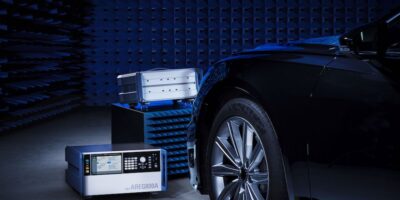
Driving scenarios for testing radar based advanced driver assistance systems (ADAS) and radar sensors used in autonomous cars are simulated entirely over the air by the Rohde & Schwarz RTS radar test system. The RTS system consists of R&S AREG800A automotive radar echo generator (back end) and the R&S QAT100 antenna array (front end).

Currently, laterally moving objects are simulated by mechanically moving antennae. The R&S RTS replaces the mechanical movement by electronically switching individual antennae in the front end on and off. Even objects moving laterally to the car at very high speed can be simulated reliably and reproducibly, says Rohde & Schwarz. The R&S RTS is able to simulate the radial velocity (Doppler shift) and the size (radar cross section) of objects at user configurable ranges, including very small ranges, adds Rohde & Schwarz. Objects can be represented by cascading multiple R&S AREG800A back ends.

The R&S RTS moves tests currently performed on the road into the lab. This allows early error detection and a significant reduction in costs, claims Rohde & Schwarz.

The number of radar sensors in vehicles is growing, with long range radars required by NCAP (New Car Assessment Program), and an increasing number of corner radars are installed that can also monitor objects moving laterally. The latest generation of radar sensors have integrated RF antennae and signal processors for object recognition on the same chip. That is why the objects to be recognised need to be simulated over the air in radar sensor tests, argues Rohde & Schwarz.

The R&S RTS – consisting of the R&S AREG800A back end and the R&S QAT100 antenna array front end – is a target simulator that generates dynamic radar echoes that can be used at all stages of automobile radar sensor testing – from pre-development through hardware-in-the-loop lab tests to validation of ADAS/autonomous functions integrated in the vehicle.

The back end can simulate a large number of independent artificial objects and dynamically vary their range, size (radar cross section) and radial velocity. With an instantaneous bandwidth of 4GHz between 76 and 81GHz, it covers the typical frequency range of current and future automotive radar sensors.

The front end uses up to 192 independently switchable antennae to simulate objects moving laterally to the car’s direction of movement, providing very fine resolution, high switching speed and high repeatability. Electronic switching of the antennae does not cause any wear to RF cables and other moving parts, as is otherwise encountered with mechanical antenna motion used in traditional test systems. An optional transmit array makes it possible to simulate two objects very close together and moving laterally to the car. The small patch antennae and the absorber-lined surface provide a low-reflection RF front end with a very small radar cross section. This reduces the sensor’s noise floor and suppresses close range targets and potential multi-path reflections. The antenna spacing of just 3.7mm delivers very fine angular resolution. Multiple front ends can be combined to cover larger fields of view of radar sensors. An angular resolution of less than 0.5 degrees is possible.

From simple scenarios such as automatic emergency breaking, the R&S RTS is modular and can be extended to cover very complex scenarios with multiple radar sensors. Any number of R&S QAT100 front ends and R&S AREG800A back ends can be combined. One of the back ends synchronises all the components installed in the set up. A graphical user interface (GUI) with a touchscreen makes it easy to configure the test set up.

For test automation with industry-standard tools, the R&S RTS comes with a hardware-in-the-loop (HiL) interface conforming to the ASAM Open Simulation Interface specification.

http://www.press.rohde-schwarz.com

> Read More

Rutronik offers MaxLinear G.hn Wave 2 family for high-speed networking

The ITU-T G.Hn standard for home networks puts an end to incompatibility in networking, says Rutronik, which has added MaxLinear’s G.hn Wave-2 products.

The Internet signal is distributed over any wired medium, meaning that power and telephone lines, twisted pair and coaxial cables have become the fast lane for data rates up to 2Gbits per second. MaxLinear‘s G.hn Wave-2 series include a baseband processor, analogue front end and Ethernet PHY as well as RGMII (1Gbit per second) or SGMII (2.5Gbits per second) interfaces. The MaxLinear G.hn Wave-2 series is available from distributor Rutronik.

There are three options for the G.hn baseband processor (88LX5152, 88LX5153 and 88LX5153A) and three options for the G.hn analogue front end (88LX2720, 88LX2730 and 88LX2741), allowing system designers to add flexibility to combine and match components.

The components are suitable for a wide range of G.hn applications in home networking and broadband, factory automation, smart building, smart grid, smart metering and smart cities. Rutronik adds that security-relevant applications, such as security cameras and door security systems, benefit from the fast transmission of high data rates.

Specifically adapted evaluation kits are available for powerline, phone line / twisted pair as well as coaxial cable.

Rutronik Elektronische Bauelemente claims to be one of the leading distributors in Europe. It has over 80 local offices around the globe for an international network. The broadline distributor supplies semiconductors, passive and electromechanical components as well as boards, storage, displays and wireless products. The company‘s primary target markets are the automotive, medical, industrial, home appliance, energy and lighting industries.

The Rutronik Embedded, Rutronik Smart, Rutronik Power and Rutronik Automotive provide customers with specific products and services in groups tailored to the respective applications. The distributor offers technical support for product development and design-in, individual logistics and supply chain management solutions as well as comprehensive services complete its scope of performance.

The company was founded in 1973 by Helmut Rudel in Ispringen, Germany.

https://www.rutronik.com

> Read More

About Smart Cities

This news story is brought to you by smartcitieselectronics.com, the specialist site dedicated to delivering information about what’s new in the Smart City Electronics industry, with daily news updates, new products and industry news. To stay up-to-date, register to receive our weekly newsletters and keep yourself informed on the latest technology news and new products from around the globe. Simply click this link to register here: Smart Cities Registration