

New 65V energy-aware digital power monitors from Microchip
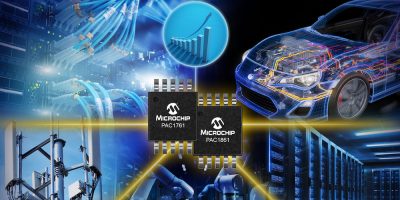
As automotive, AI/data centre, networking and industrial systems quickly migrate toward 48V power architectures to improve efficiency and support higher power demands, designers need more than visibility into instantaneous voltage and current conditions. They need systems that understand energy use over time and can respond intelligently to changing power conditions. Microchip has announced the PAC1761 and PAC1861 families of 65V energy-aware digital power monitors that combine accumulated power-measurement insights with the necessary high-voltage measurement headroom and transient spike protection capabilities to help make 48V power architectures more efficient and resilient.
The move to 48V power architectures demands that digital power monitors have an additional operational margin of up-to-65V measurement and 75V of spike protection to ensure transient survivability. The PAC1761 and PAC1861 devices add to these capabilities the intelligence to understand and react in real time to energy usage dynamics based on accumulated power measurement data.
Microchip’s digital power monitoring devices feature programmable alerts for voltage, current and power excursions, step-limit detection to identify sudden load changes, and configurable accumulated-energy thresholds that enable proactive system management based on both instantaneous and long-term power behaviour.
Target applications include automotive, AI/data centre, networking, industrial, server, telecom/Power over Ethernet (PoE) and 48V power distribution systems. The 12-bit PAC1761 and 16-bit PAC1861 options are available in VDFN-8 (similar to SOT23-8), VDFN-10 and MSOP-10 packages including automotive-orderable variants. Pin-compatible options can reduce redesign risk, shorten qualification cycles and give customers flexibility to move between devices as requirements, availability, cost or performance change.
Development Tools
Development support includes evaluation board EV12R33A, a Python Command Line Interface (CLI) with library, Linux® driver and generic C library with multiple MCU code examples.