

NXP introduces MCX A5 MCUs to simplify secure industrial edge connectivity
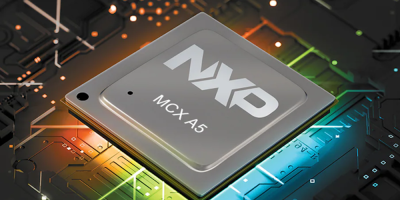
NXP Semiconductors has announced the MCX A5 family of MCUs, simplifying secure connectivity for industrial and IoT edge applications. The MCX A5 family delivers the industry’s first implementation of topology discovery enabled on a wired MCU with 10BASE-T1S Ethernet digital PHY, secured by post-quantum cryptography (PQC). Developers are able to connect more industrial edge devices while preparing designs for evolving cybersecurity requirements.
According to Omdia , artificial intelligence and edge processing integration are accelerating across industrial automation use cases. This reflects a growing trend of manufacturers connecting equipment for greater operational intelligence. However, many industrial edge devices today remain disconnected or rely on legacy connections such as RS-232 and RS-485, limiting access to the real-time operational data needed to enable effective automation.
NXP’s new MCX A5 MCU family helps customers connect more edge nodes to Ethernet without the cost and complexity traditionally associated with industrial networking. By extending secure connectivity to more endpoints, manufacturers can access richer operational data for predictive maintenance, intelligent energy management, industrial automation, edge AI and more.
The MCX A5 family is built on an Arm® Cortex®-M33 core, running up to 240 MHz. Integrated 10BASE-T1S digital PHY supports compact, low-cost multi drop Ethernet networks for distributed industrial nodes, reducing components, cost, and design complexity for industrial connectivity.
Designed for long product lifecycles, the MCX A5 family combines PSA Certified Level 3 security with support for PQC, including a PQC-based hardware root of trust including secure boot, secure firmware updates, secure attestation and secure debug authentication. Selected devices also support the Rust programming language, enabling developers to adopt modern, memory-safe software development practices. The MCX A5 family is supported by NXP’s MCUXpresso software and tools ecosystem, including the MCUXpresso SDK with Long Term Support (LTS) releases, development tools, middleware and security enablement. The family also supports Zephyr RTOS, providing developers with flexibility to leverage both commercial and open-source software environments that bring long-term product maintenance and security updates. Together, these capabilities help developers build and maintain secure connected products while addressing evolving cybersecurity requirements, including those introduced by the European Cyber Resilience Act.
When paired with NXP’s TJF1410 10BASE-T1S Physical Medium Dependent (PMD) transceiver, the MCX A5 family provides a complete single pair Ethernet (SPE) solution for industrial and building automation applications, with the TJF1410 acting as the analog front-end to the MCX A5’s integrated digital PHY. The TJF1410 is optimised for IEEE 802.3cg-compliant 10BASE-T1S networks and complements the MCX A5’s integrated digital PHY, simplifying the system design and reducing the bill-of-material costs for industrial automation, building automation, energy infrastructure and other distributed edge applications.
The MCX A5 family offers up to 2 MB Flash, 640 KB RAM and a rich set of connectivity interfaces, including UART, I²C, I3C, SPI, CAN FD, High-Speed USB and FlexIO, giving developers flexibility. Along with support from NXP’s FRDM development boards, the MCX A5 family is supported by the MCUXpresso developer ecosystem, including Rust support, comprehensive SDKs, Visual Studio Code integration and LTS software releases.